
ABM strategy · account-based GTM · 2026 guide
Account-based marketing strategy how to plan, run and measure ABM
An ABM strategy decides which companies you want as customers, who inside them makes the decision, and what you will do, channel by channel and week by week, to win them.
It is account-based GTM strategy: marketing, sales and customer success working one list instead of chasing leads one form fill at a time.
This guide covers the three tiers of ABM, how to pick and tier accounts, buying-group mapping, the plays by channel, intent signals, budget, measurement, tools and a 90-day plan.
Every figure links to its source.
GTM Quest builds and runs ABM programs for B2B teams from London; if you want help, book 15 minutes.
Reviewed by Dan Keegan, GTM Quest · October 16, 2026 · 14 sources linked below
How an ABM program runsthe order we build it in
- 01Accounts chosen and tieredWEEKS 1 TO 2FIT · INTENT · RELATIONSHIP
- 02Buying groups mappedWEEKS 2 TO 4ROLES · CONTACTS · GAPS
- 03Plays launched by tierWEEKS 4 TO 8ADS · CONTENT · OUTBOUND
- 04Measured on pipelineMONTHLYENGAGEMENT · WIN RATE
ABM tiers3
01/ the definition
What is account-based marketing? and what it is not
Account-based marketing (ABM) treats a named company, not an individual lead, as the market.
You choose the accounts first, then build marketing and sales activity around the people who buy inside them.
The term was coined in 2003 by Bev Burgess, then European vice president of ITSMA.
An ABM strategy is the plan that makes that work: which accounts, in which tier, with which plays, owned by whom, measured how.
Without the plan, ABM collapses into "LinkedIn ads to a list", which is a tactic, not a strategy.
The reason it matters is how B2B buying now works.
Gartner found buying groups ranging from five to 16 people across as many as four functions, and Forrester's 2026 study puts the typical purchase at 13 internal stakeholders and nine external influencers.
A lead-by-lead funnel reaches one of them.
ABM is built to reach the group.
What ABM is not
Not a tool. An ABM platform runs parts of the program; it does not choose your accounts or write your message.
Not just ads. Advertising warms an account; it rarely closes one on its own.
Not a marketing-only project. If sales does not work the same list, it is targeted advertising with a new name.
Not every account. ABM is a choice to spend more on fewer companies.
If your list has 20,000 names and no tiers, you are running demand generation, which is fine, but see our demand generation page instead.
ABM vs demand generation and lead generation
Demand generation builds awareness across the whole market; lead generation captures individuals who raise a hand.
ABM narrows the field to accounts you have chosen and measures progress by account, not by lead.
Most healthy go-to-market plans run all three, with ABM reserved for the accounts worth the extra cost.
For the wider plan, see our GTM strategy guide.
02/ the three tiers
One-to-one, one-to-few, one-to-many the three types of ABM
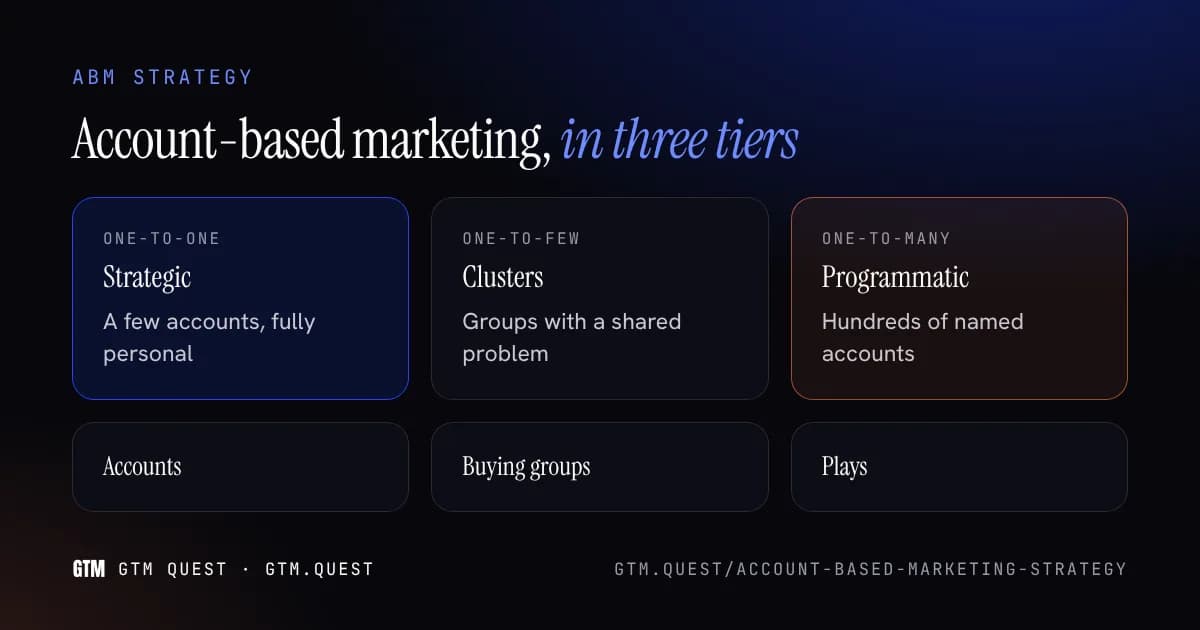
ITSMA's model, set out by Bev Burgess and Dave Munn in A Practitioner's Guide to Account-Based Marketing, names three types: Strategic, Lite and Programmatic.
Most programs run more than one at once.
1:1
Strategic ABM (one-to-one)
A dedicated plan for a single account, built with the account team.
Research, messaging and content are written for that company and its people.
Highest cost per account, longest timeline, biggest deals.
- ✓ For example: 5 to 10 accounts per marketer
- ✓ Custom content, executive events, account plans
- ✓ Owned jointly with the account executive
- ✓ Measured on relationship depth and deal value
Best for your largest existing customers and must-win logos.
1:few
ABM Lite (one-to-few)
Small clusters of accounts that share an industry, a problem or a trigger event.
Each cluster gets its own message and content, lightly tailored per account.
- ✓ For example: clusters of 10 to 30 accounts
- ✓ Industry or problem-specific content
- ✓ Coordinated ads, outbound and small events
- ✓ Measured on engaged accounts and pipeline per cluster
Best for a vertical push or a cohort sharing one trigger.
1:many
Programmatic ABM (one-to-many)
Hundreds or thousands of accounts that fit your ICP, reached with technology: account-targeted ads, intent-triggered outbound and personalization by segment.
- ✓ For example: 200 to 2,000 accounts
- ✓ Segment-level messaging, not account-level
- ✓ Intent and engagement scoring decide who gets more
- ✓ Measured on account engagement and opportunity rate
Best for mid-market and for finding which accounts to move up a tier.
Momentum ITSMA's benchmark reports that one-to-one is the most popular type of ABM program, followed by one-to-few and one-to-many.
In practice, the tiers feed each other: one-to-many finds the accounts that are warming up, and the best of them move into one-to-few or one-to-one.
The account counts above are examples to show the scale, not rules.
Your numbers depend on deal size and how many people you have.
03/ step one
How to choose and tier target accounts fit, intent, relationship
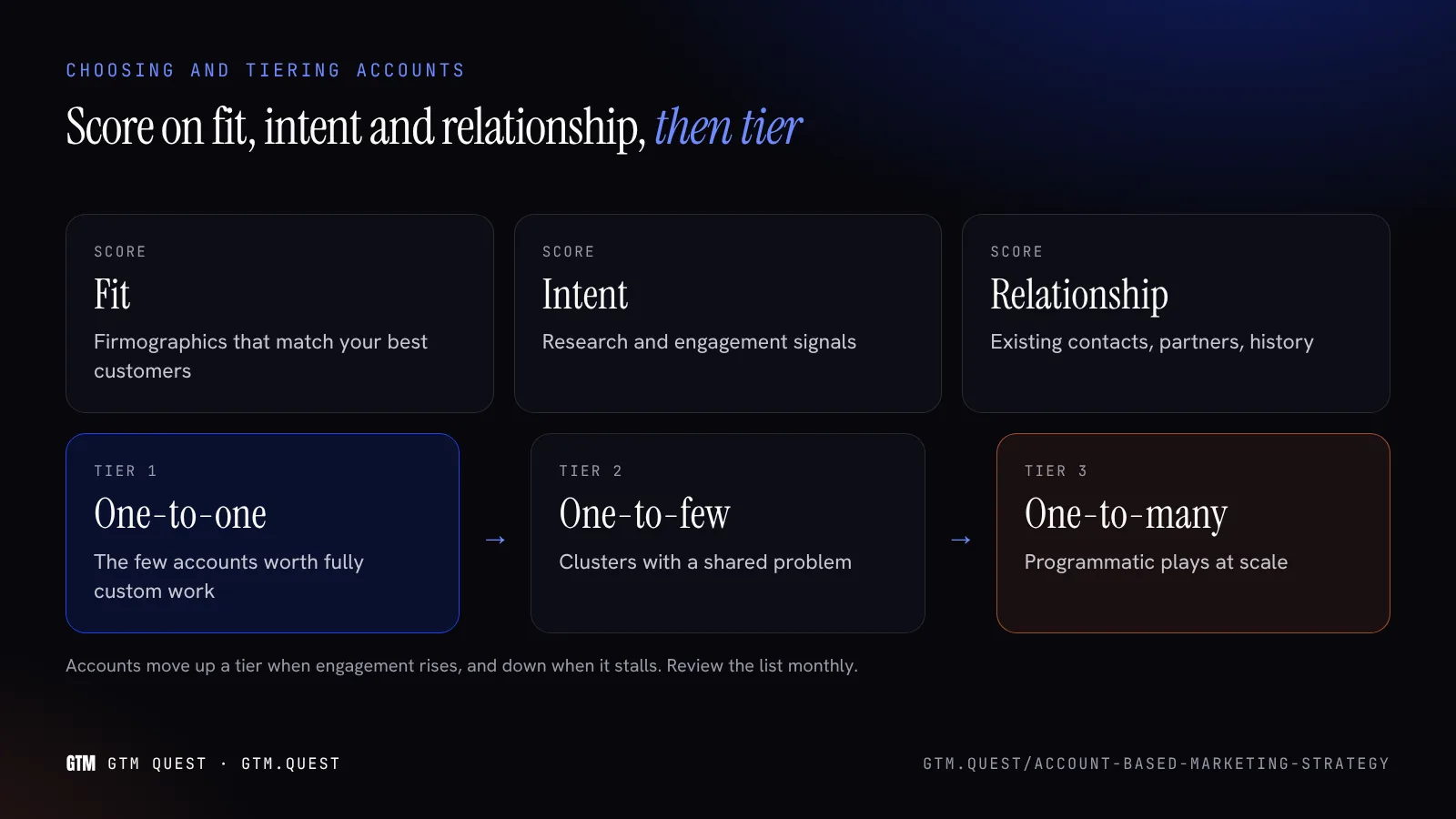
Score every account on three things.
Fit is fixed for a year; intent and relationship change every month, so re-tier quarterly.
The tiering rule we use. High fit and high value with a live relationship or strong intent goes to one-to-one or one-to-few.
High fit without intent sits in one-to-many until a signal moves it.
Low fit comes off the list, however loud the intent.
Agree the list with sales before any campaign runs.
If account executives would not call an account, it should not be in a one-to-one tier.
Our GTM scorecard checks whether your ICP is written down well enough to do this.
04/ step two
Buying-group mapping who actually decides
Once the accounts are chosen, map the people.
For each account, list the roles that take part in a decision like yours, then find the named person in each role.
The gaps are your first job.
The research agrees the group is large; it differs on the count because it measures different things.
Gartner reports five to 16 people across as many as four functions.
Forrester counts 13 internal stakeholders and nine external influencers and says 73% of purchases involve three or more departments.
Demandbase, from its own customer data, says a typical buying group includes 13 to 17 stakeholders.
Size is not the only problem.
Gartner found 74% of B2B buyer teams demonstrate unhealthy conflict during the decision, and that groups that reach consensus are 2.5 times more likely to report a high-quality deal.
Good ABM gives each role the material it needs to agree with the others.
The roles to map
Economic buyer (signs the budget).
Champion (wants the change and will sell it internally).
Users (live with the product).
Technical evaluator (security, IT, integration).
Procurement (Forrester says procurement professionals are decision-makers in 53% of business buying cycles).
Blockers (whoever loses something if you win).
Message to the group, not the person
Gartner's research found tailoring for buying-group relevance positively impacts consensus by 20%, while relevance only to the individual had a 59% negative impact on group consensus.
Write the core message for the shared problem, then give each role its own proof.
05/ step three
ABM plays by channel what runs in each tier
The same channels show up in every tier.
What changes is how much each touch is tailored and who sends it.
Demandbase reports that accounts with sustained advertising to the buying group convert to opportunities at two to three times the rate of accounts without advertising.
That is Demandbase's analysis of its own customers, and correlation, not proof that ads cause the lift.
Use it as a reason to test, not a forecast.
Tailoring is not optional on the outbound lane.
Gartner found 73% of B2B buyers actively avoid suppliers who send irrelevant outreach.
06/ orchestration
Orchestration over eight weeks one-to-few, week by week
For example: a cluster of 15 fintech accounts that all posted a head of compliance role this quarter.
Every lane aims at the same accounts; each week adds one touch.
Problem-led ads start
Cluster landing page live
Point of view on the trigger
Quiet this week
Quiet this week
Baseline engagement
Running
Quiet this week
Quiet this week
Champion outreach starts
Quiet this week
Who engaged?
Swap in the cluster report
Industry report published
Report highlights
Follow up with report
Quiet this week
Re-tier movers
Running
Quiet this week
Quiet this week
Economic buyer outreach
Invites out
Who engaged?
Case study ads
Look-alike case study
Customer story
Invite to roundtable
Quiet this week
Re-tier movers
Running
Quiet this week
Quiet this week
Technical evaluator outreach
Roundtable
Who engaged?
Retarget engaged roles
Roundtable recap
Roundtable takeaways
Follow up after event
Quiet this week
Re-tier movers
Review
Quiet this week
Quiet this week
Meeting asks
Quiet this week
Pipeline readout
The point of orchestration is sequence: ads and content warm the group before a seller reaches out, so the first email lands with someone who has already seen your name.
The weekly review decides which accounts get more and which drop back a tier.
07/ signals
Signals and intent data what moves an account forward
Intent data tells you who might be looking.
Your own first-party signals tell you who is looking at you.
Use both, and act on the change, not the level.
Fits the ICP, no activity
The signal
Fit score only; no intent or engagement in 90 days
The play
One-to-many ads and founder content to build familiarity
Owner: Marketing
Reading about the problem
The signal
Rising third-party topic intent; a job post naming your problem; a new leader in the buying role
The play
Cluster content and ads; light outbound to the likely champion
Owner: Marketing and SDR
Reading about you
The signal
Several people from the account on your site, pricing or case study pages; ad engagement from mapped roles
The play
Move up a tier; multi-threaded outreach; invite to an event
Owner: SDR and AE
Talking to sales
The signal
Meeting held; opportunity open in the CRM
The play
Role-specific proof for each buyer; executive sponsor contact
Owner: AE
Closed, then expanding
The signal
Usage, new teams, renewal window
The play
Expansion plan as a one-to-one or one-to-few account
Owner: CS and AE
Timing matters because buyers decide early.
6sense's 2025 study of nearly 4,000 buyers found buyers initiated 79% of first contacts, first contact came at about 61% of the journey, and buyers chose from their day-one shortlist 95% of the time.
If an account only hears from you once it is "in market", you are usually too late.
Most of your list is not buying this quarter.
Professor John Dawes of the Ehrenberg-Bass Institute estimates up to 95% of business buyers are out of market at any one time, a heuristic derived from five-year replacement cycles.
That is why one-to-many ABM keeps reaching accounts with no intent yet.
08/ resources
ABM budget and team what it takes to run
In the Momentum ITSMA and ABM Leadership Alliance benchmark, respondents reported 28% of marketing budget dedicated to ABM in 2022, and 71% planned to increase it.
That is a survey average from teams already committed to ABM, not a target for yours.
A better way to size the budget is bottom up: tier counts times the plays each tier gets.
One-to-one accounts cost mainly people's time.
One-to-few costs content and events.
One-to-many costs media and data.
Price each line, then check the total against the pipeline value of the accounts.
The minimum team
An ABM lead who owns the list, the plan and the readout.
Sales partners: account executives and SDRs who work the same accounts.
Content that can write for one industry or one company.
Ops: someone who keeps account data, intent feeds and CRM reporting working, often a GTM engineer or RevOps.
Paid media and design can be shared or outsourced.
Small teams can start with one person and two account executives on a one-to-few pilot.
If you need senior leadership to own it part-time, see fractional CMOs.
09/ measurement
How to measure ABM engagement, pipeline, win rate, deal size, velocity
Measure by account and compare against a control group of similar accounts you did not target.
Without a control, every number is a story.
Read the benchmarks for what they are.
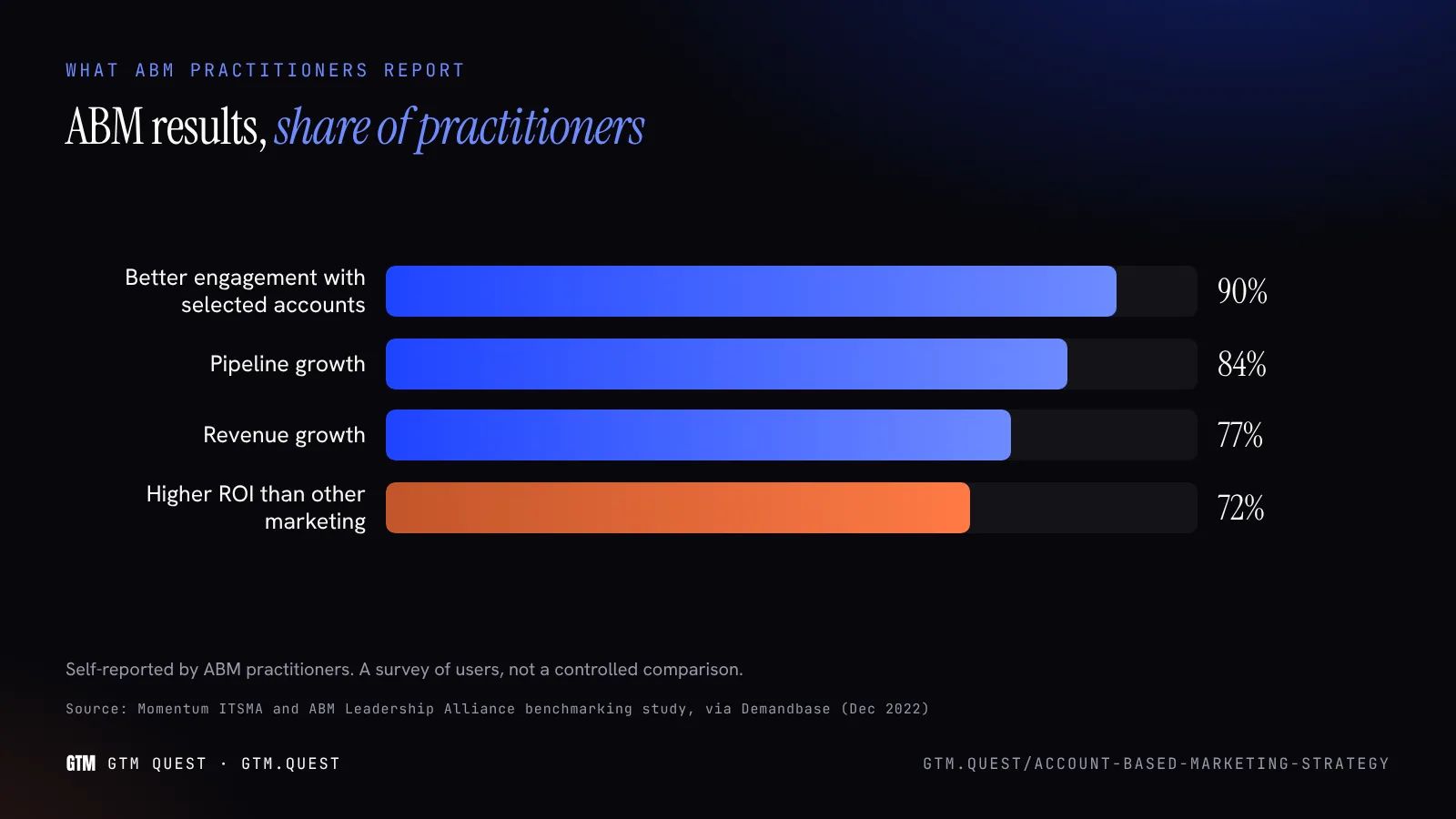
The Momentum ITSMA figures are the share of practitioners reporting an improvement, not the size of it.
The Demandbase figures come from its own platform data and are correlations.
Neither is a promise of what your program will return.
Report monthly on engaged accounts and pipeline, and quarterly on win rate, deal size and velocity.
Deal outcomes take a full sales cycle to show.
10/ the stack
ABM tools and platforms organized by job, not ranked
Buy tools for a job you already know you need.
Most teams start with a CRM, LinkedIn and a data source, and add an ABM platform when one-to-many grows past what they can run by hand.
Each vendor describes its own scope; check what is in the plan you are quoted.
Our stack is Clay for data and signals, our own Postgres database for account history and scoring, your CRM as the record, and LinkedIn for account-targeted ads.
The GTM engineer page explains how that is built.
11/ the plan
A 90-day ABM plan pilot before you scale
Start with one tier and one cluster, prove engagement and meetings, then widen.
A pilot that sales trusts beats a launch nobody uses.
Agree the ICP and the list
Write the ICP with sales, score accounts on fit, intent and relationship, and pick a pilot: one cluster of one-to-few accounts plus a one-to-many layer behind it.
- ✓ ICP signed off by sales
- ✓ Scored and tiered account list
- ✓ A control group of similar accounts
- ✓ Baseline engagement and pipeline
Map buying groups and build assets
Fill the roles for every pilot account, write the cluster message and build the first content and ads.
- ✓ Roles and named contacts in the CRM
- ✓ Cluster message and proof per role
- ✓ Landing page and first report
- ✓ Ad audiences built
Launch the orchestrated plays
Ads and content first, then outbound by role, then an event or roundtable.
Review engagement every week and move accounts between tiers.
- ✓ Ads and content live
- ✓ Outbound by role
- ✓ One event or roundtable
- ✓ Weekly engagement review
Read out and decide
Compare the pilot accounts with the control group on engagement, meetings and pipeline.
Keep what worked, cut what did not and plan the next cluster.
- ✓ Pilot versus control readout
- ✓ Sales feedback on account quality
- ✓ Next cluster chosen
- ✓ Budget for the next quarter
Ninety days is enough to judge engagement and meetings, not win rate.
Keep tracking the pilot accounts through a full sales cycle before you call the result.
12/ our service
How GTM Quest runs ABM four ways to work with us
We are a GTM agency in London.
ABM is one part of the go-to-market systems we build for B2B teams.
What do you need from an ABM partner?
Strategy and setup
We build the ABM strategy and hand it over
ICP, scored and tiered list, buying-group maps, cluster messaging and the 90-day plan, documented for your team to run.
- ✓ ICP and tiered account list
- ✓ Buying-group maps in your CRM
- ✓ Cluster messages and first assets
- ✓ Measurement plan with a control group
Best when you have marketers and sellers but no plan.
Pilot
We run a 90-day one-to-few pilot
One cluster, run end to end with your sales team: ads, content, outbound and a readout against a control group.
- ✓ One cluster of target accounts
- ✓ LinkedIn ads and content
- ✓ Signal-led outbound on Clay
- ✓ Pilot versus control readout
Best before you commit budget to a platform.
Embedded
We run the program with your team
Weekly orchestration, re-tiering, content and outbound, reported monthly on engaged accounts and pipeline.
- ✓ Weekly orchestration
- ✓ Quarterly re-tiering
- ✓ Monthly pipeline reporting
- ✓ You keep the data and accounts
Best when you want output before you hire.
Full GTM
ABM inside a full go-to-market build
ABM alongside positioning, demand generation, outbound and the systems underneath, from one data layer.
- ✓ Positioning and ICP
- ✓ ABM plus demand generation
- ✓ Outbound and LinkedIn
- ✓ CRM and RevOps
For fractional leadership, see our sister site's fractional GTM page.
Every engagement is scoped and quoted in writing after the first call.
Ad spend, data and any platform licenses are separate lines you pay directly.
13/ what goes wrong
Common ABM mistakes and how to avoid them
01
Too many accounts
A list of thousands with one message is not ABM.
Tier it, and keep the top tiers small enough to tailor.
02
Sales not on the list
If account executives did not help choose the accounts, they will not work them.
Agree the list before launch.
03
Buying the platform first
A platform without a list, a message and an owner is an expensive dashboard.
Pilot by hand, then buy what you missed.
04
One contact per account
Buying groups run to five to 16 people.
Reaching one is a lead, not an account.
05
Measuring leads
MQL counts reward the wrong behavior.
Measure engaged accounts, pipeline, win rate and deal size against a control group.
06
Personalization theater
Putting a logo on a landing page is not relevance.
Gartner found relevance to the whole group, not the individual, is what moves consensus.
07
No patience
ABM runs at the speed of your sales cycle.
Judge engagement at 90 days and revenue after a full cycle.
08
Ignoring customers
Your existing accounts are often your best one-to-one targets.
Expansion is ABM too.
14/ build or buy
ABM agency or in-house? when to hire help
Most teams end up with ABM run in-house.
The question is how to get there quickly.
Pick a comparison.
→ Hire an ABM agency to build and prove the first program, then bring it in-house once it works. That is the build-and-hand-over model we run. US teams can compare firms on our ABM agency US page.
→ If you have the people but not the plan, a GTM consultant may be enough.
Signs you need outside help: no one owns ABM, the account list has not been agreed with sales, or you are about to buy a platform without a pilot.
Our guide to choosing a go-to-market agency covers what to ask.
15 minutes · video or phone
Book 15 minutes on your ABM strategy
Bring your target account list, or the lack of one. We come back with how we would tier it, the first play we would run and what to measure, whether or not you work with us.
- 0115 minutes, video or phone
- 02We look at your accounts, CRM and channels
- 03A written next step after the call
- 04Build-and-handover, embedded or full program
Pick a day that suits · live availability
15/ questions
ABM strategy FAQ
What B2B teams search for about account-based marketing strategy, answered with sources.
The plan for account-based marketing: which accounts you target, in which tier, which plays each tier gets, who owns them and how you measure progress.
See what ABM is.
A B2B approach that treats named companies as the market and markets to the buying group inside each one.
The term was coined in 2003 by Bev Burgess at ITSMA.
Strategic ABM (one-to-one), ABM Lite (one-to-few) and Programmatic ABM (one-to-many), as named in Burgess and Munn's practitioner guide.
See the three tiers.
A go-to-market strategy where marketing, sales and customer success work one agreed list of accounts, measured by account rather than by lead.
ABM is the marketing part of it; see our GTM strategy guide for the rest.
Score accounts on fit, intent and relationship, cap the top tiers by value, and agree the list with sales.
Gartner reports five to 16 people across up to four functions; Forrester counts 13 internal stakeholders and nine external influencers in a typical purchase.
Signals that an account is researching a topic, from third-party sources or your own website and ads.
Act on rising intent in accounts that already fit.
By account: engagement, pipeline, win rate, deal size and velocity, compared with a control group.
See how to measure ABM.
In Momentum ITSMA's study of 279 practitioners, 72% said ABM delivers higher ROI than other types of marketing.
That is a reported view, not a measured return, so test it against a control group.
It depends on the job: intent data, account-based ads, data, orchestration or direct mail.
See ABM tools by job; we do not rank them.
Expect engagement and meetings within 90 days and revenue after a full sales cycle.
See the 90-day ABM plan.
Hire one to build and prove a first program quickly, then bring it in-house.
See ABM agency or in-house and our ABM agency page.

Book 15 minutes · London · UK, Europe and US
Bring your account list, or the lack of one. We’ll show you how we would tier it.
A 15-minute call, a written next step, and an ABM program built with you, then run together or handed to your team.
17/ sources
Every source on this page
Each figure above links to one of these. All were opened and checked on October 16, 2026.
- Momentum ITSMA, annual ABM Benchmarking study (PR Newswire, 2 Mar 2023; 279 respondents)prnewswire.co.uk
- Gartner, 74% of B2B buyer teams demonstrate unhealthy conflict (May 2025; 632 buyers)gartner.com
- 6sense, 2025 Buyer Experience Report6sense.com
- Built In, What is account-based marketing (ABM)?builtin.com
- Forrester, The State of Business Buying, 2026 (Jan 2026)forrester.com
- Momentum ITSMA, ABM Benchmark 2024momentumitsma.turtl.co
- Bev Burgess and Dave Munn, A Practitioner’s Guide to Account-Based Marketing, 2nd edition (Kogan Page, 2021), front mattercdn.koganpage.com
- Forrester, Three realities about B2B buying networksforrester.com
- Demandbase, State of ABM 2026 benchmark report (1,452 tenants)demandbase.com
- LinkedIn Marketing Solutions, Company targetingbusiness.linkedin.com
- Gartner, 61% of B2B buyers prefer a rep-free buying experience (June 2025)gartner.com
- Ehrenberg-Bass Institute (John Dawes), the 95-5 rule (2021)marketingscience.info
- ABM Leadership Alliance and Momentum ITSMA, sixth annual ABM benchmark report (Demandbase press release, Dec 2022)demandbase.com
- Fractional Quest, Fractional GTMfractional.quest