
AI SDR · AI sales agents · Outbound
AI SDR and AI sales agents what they do, where they fail
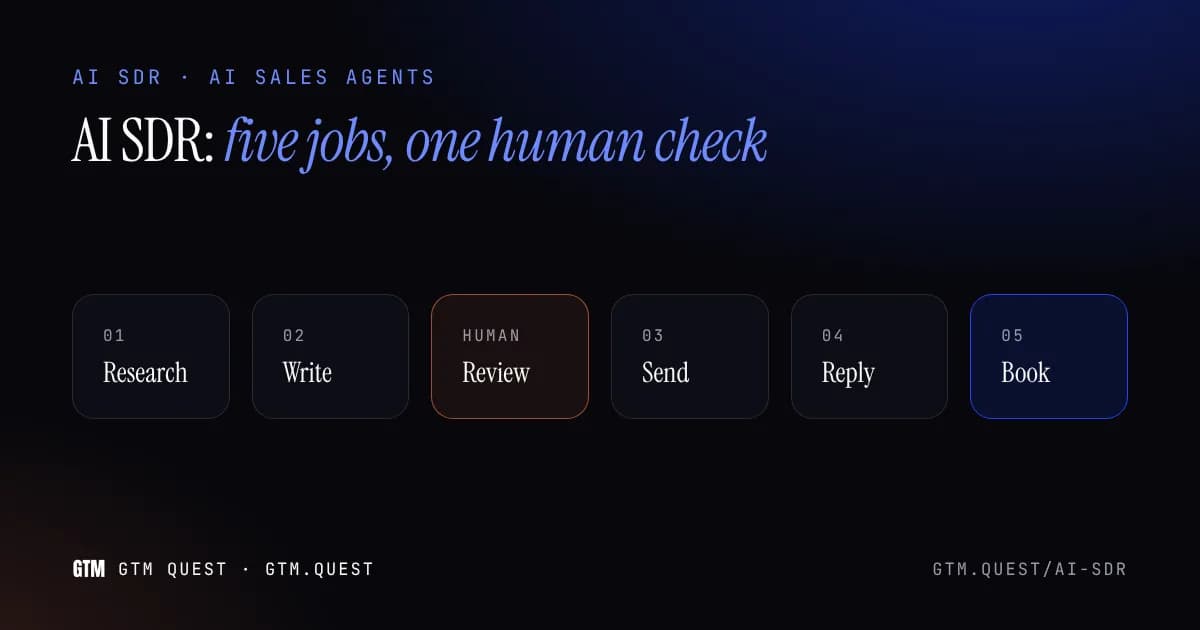
An AI SDR is software that does some or all of a sales development rep's job: it researches accounts, writes outreach, sends it, handles replies and books meetings.
In our experience the software is strongest at the first two jobs and riskiest at the last three.
GTM Quest builds outbound systems that use AI for research and drafting, with a person approving what goes out.
This page is the guide we wish buyers read first: what the tools do, where they break, the rules, the economics and how to decide.
Reviewed by Dan Keegan, GTM Quest · October 16, 2026 · 22 sources linked below
How we run AI outbounda human approves every send
- 01Accounts and dataWEEK 1ICP · NEON POSTGRES
- 02Enrichment and signalsWEEKS 1 TO 2CLAY
- 03Research and draftsDAILYCLAUDE
- 04Review, send, bookDAILYHUMAN IN THE LOOP
Sends without review0
01/ the definition
What is an AI SDR? and what is an AI sales agent
An AI SDR (AI sales development representative) is a software agent that does prospecting work a human SDR would otherwise do.
It finds and researches accounts, writes a message, sends it on a schedule, reads the replies and, in the more ambitious products, books the meeting.
Some vendors call theirs an AI BDR; the job is the same.
AI sales agent is the wider term.
It covers any agent that acts inside a sales workflow, not only prospecting: inbound qualification, meeting prep, CRM updates, deal follow-up.
Salesloft, for example, announced 15 new agents in 2025 for a total of 26 across the revenue cycle, most of them assisting reps rather than replacing them.
The useful distinction is not the label.
It is who presses send.
An autonomous AI SDR sends and replies on its own.
An AI-assisted human SDR uses the same research and drafting, but a person checks the message, sends it and handles the conversation.
Most of the value, and almost none of the risk, sits in the second model.
AI SDR vs AI-assisted SDR
Autonomous: the agent researches, writes, sends and replies; a human sees the meeting on the calendar.
Assisted: the agent researches and drafts; a human approves, sends and talks.
Many tools offer both.
Artisan, for example, says its agent has an approval mode that drafts replies for review.
02/ by job
What AI SDR tools actually do job by job
Split the SDR role into its five jobs and judge the software on each one.
The vendor examples are what each vendor says on its own site, checked on October 16, 2026.
The pattern is consistent across vendors: research and drafting are mature, sending is infrastructure work, and autonomous replies are where most of the brand risk lives.
For the infrastructure side, see our cold email agencies and lead generation pages.
03/ the market
AI SDR and AI sales agent tools what each vendor says it does
Unranked and unpaid.
Each description is the vendor's own claim from its site on October 16, 2026.
We do not repeat vendor performance figures because none is independently verified.
Autonomous AI SDR
11x
11x sells named agents: Alice for outbound email and social, Julian for inbound, and a voice agent.
It describes them as "fully managed, CRM-native, live in days".
Positioned as a replacement for SDR headcount.
Autonomous AI BDR
Artisan
Artisan's agent, Ava, finds leads in a contact database it says holds 250M+ contacts, runs sequences, handles replies and books meetings.
Artisan says the platform replaces several other sales tools.
Has an approval mode for human review.
AI SDR, published pricing
AiSDR
AiSDR publishes its prices: $1.50 per person prospected on pay as you go, volume-priced team plans for teams contacting 1,000+ people a month, and a $2,500 a month fully managed service.
It says its agent plans and runs outbound across email and LinkedIn.
One of the few vendors with prices on its site.
Research agents
Clay
Clay's Claygents take inputs, follow your instructions and write a structured output, with a reasoning trace for each decision.
Clay does not send email itself; it feeds a sequencer or CRM.
The research layer in most GTM engineering stacks, ours included.
Data plus AI
Apollo
Apollo says its AI works on 240M contacts and 30M companies, writes emails, automates engagement across email and phone, and can run as a co-pilot or on autopilot.
Database, sequencer and AI in one tool.
Sales engagement
Outreach
Outreach launched an AI Prospecting Agent in March 2025 that it says researches accounts, writes personalized messaging and runs around the clock inside its platform.
For teams already on Outreach.
Sales engagement
Salesloft
Salesloft says it has 26 AI agents available or in development, including account research, and frames them as support for sellers rather than a replacement.
For teams already on Salesloft.
How to read vendor numbers. Most AI SDR sites quote customer reply rates, pipeline or ROI.
Treat these as case studies chosen by the seller, not benchmarks.
Ask for the denominator: how many contacts, how many domains, over what period, and how many meetings turned into opportunities.

04/ failure modes
Where AI SDRs fail and how to see it coming
These are the failures we see when teams switch an AI SDR on without the groundwork.
None of them is about the model being clever enough.
01
Bad data in, confident nonsense out
An agent researching the wrong accounts, or the right accounts with stale contacts, produces polished emails to people who left last year.
The model cannot tell you the list is wrong.
- ✓ Deduplicate against your CRM first
- ✓ Verify emails before sending
- ✓ Refresh contacts on a schedule
02
Deliverability
Autonomous tools make it easy to send more than your domains can carry.
Gmail tells bulk senders to keep user-reported spam below 0.1% and never reach 0.3%.
Once a domain's reputation drops, good emails go to spam too.
- ✓ Separate sending domains
- ✓ SPF, DKIM and DMARC on each
- ✓ Volume caps per mailbox
03
Hallucinated personalization
The agent "congratulates" someone on a funding round that did not happen, cites a podcast they never recorded, or misreads a job post.
One invented fact undoes the point of personalizing.
- ✓ Every claim traced to a source field
- ✓ No fact without a URL
- ✓ Human check before send
04
Brand risk
Your name is on every message.
Gartner found 73% of B2B buyers actively avoid suppliers who send irrelevant outreach, so a high-volume, low-relevance campaign can cost you accounts you have not met yet.
- ✓ Tight ICP, small batches
- ✓ A do-not-contact list across channels
- ✓ Read a sample of every batch
05
Replies handled badly
An agent that answers a pricing question wrongly, keeps pitching after "not interested" or books a meeting with a student wastes the most valuable moment in the funnel.
- ✓ Humans answer interested replies
- ✓ Hard stop on opt-outs
- ✓ Qualification rules before booking
06
Measuring the wrong thing
Emails sent and meetings booked are easy to inflate.
Pipeline created and meetings held are not.
Many AI SDR dashboards report the first pair.
- ✓ Report meetings held
- ✓ Report opportunities created
- ✓ Compare against a control segment
Salesforce's State of Sales points the same way: 51% of sales leaders with AI say disconnected systems are slowing their AI initiatives, and 74% of sales professionals say they are focusing on data cleansing.
The bottleneck is data, not prompts.
05/ the rules
AI SDR email rules US, UK and EU
An AI SDR does not change the rules for cold outreach; it makes breaking them faster.
These are the rules most relevant to B2B outbound, from the official pages.
This is not legal advice.
Two practical points. First, the FTC is explicit that you cannot contract away your legal responsibility by hiring someone else to send: the same applies to software.
Second, most B2B prospects sit on company domains, so the Gmail and Yahoo thresholds are a floor for domain health, not a permission slip below 5,000 a day.
06/ the economics
AI SDR vs human SDR cost what the numbers do and do not say
The honest comparison is not a software subscription against a salary.
It is the cost of a meeting that turns into pipeline, and nobody publishes that for AI SDRs yet.
Simple arithmetic, not a benchmark. $80K OTE is about $6,700 a month in cash compensation alone.
At AiSDR's $1.50 rate, that would pay for about 4,400 people prospected a month.
It does not follow that the software is cheaper per qualified meeting: that depends on meetings held and pipeline created, which you have to measure in your own market.
If you are pricing SDR roles, our GTM salary guide covers sales development pay.
The Bridge Group data is mostly North American: 78% of its 351 companies are North America-based.
07/ the evidence
Do AI SDRs work? what the research says
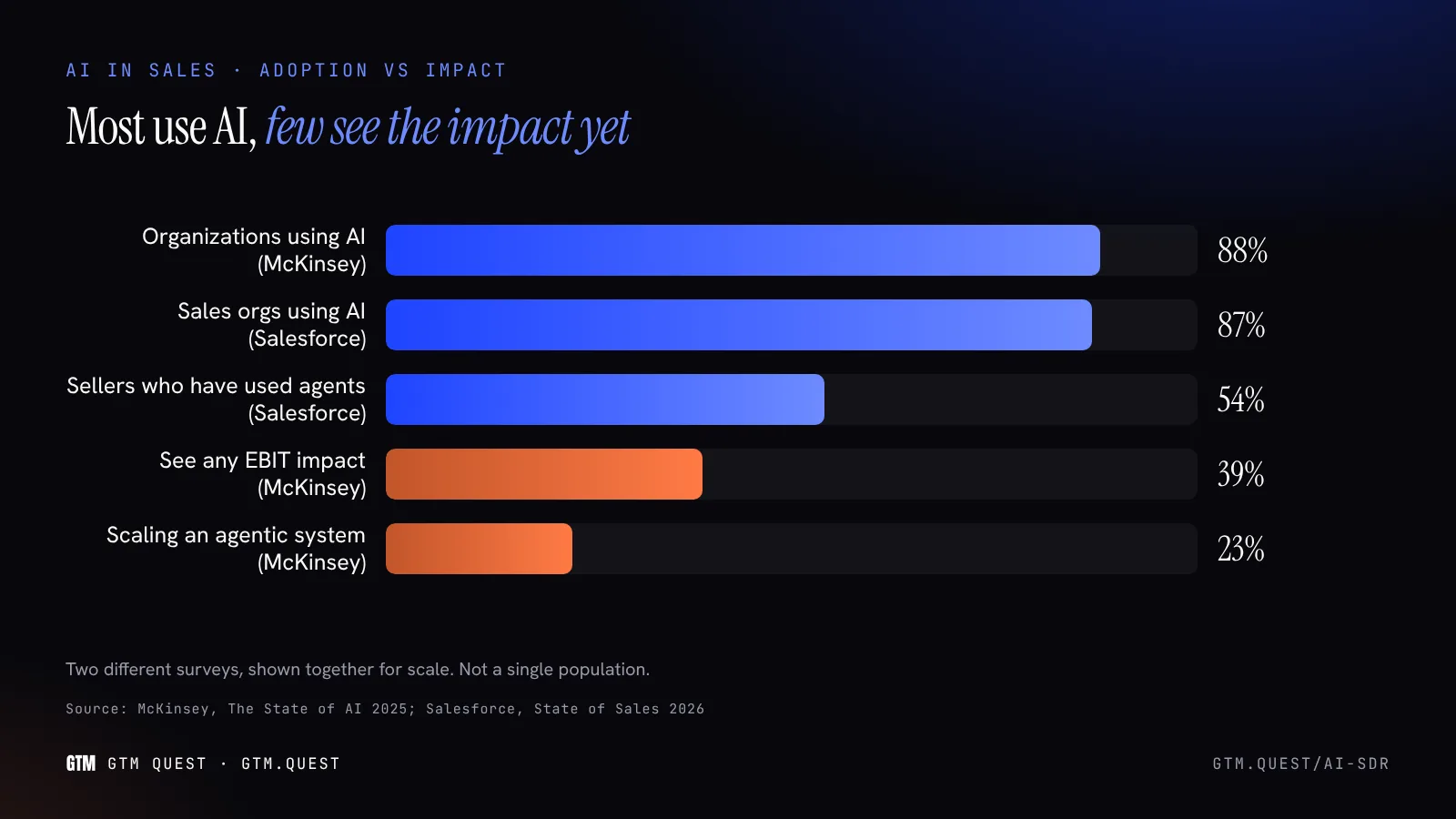
Use is close to universal; impact is not.
McKinsey's 2025 survey found 88% of organizations use AI regularly in at least one function, but only 39% attribute any EBIT impact to it, and 23% report scaling an agentic AI system.
Its 2026 edition, published in August, puts use at nearly nine in ten and EBIT impact at 37%.
In sales specifically, Salesforce's State of Sales 2026 reports that 87% of sales organizations use some form of AI and 54% of sellers say they have used agents.
Sellers in the same survey expect agents to cut prospect research time by 34% and email drafting by 36%.
Those are expectations, not measured results.
Gartner's forecast is the most useful caution.
It predicts that by 2028 AI agents will outnumber sellers ten to one, yet fewer than 40% of sellers will say agents improved their productivity.
Gartner first made the prediction in November 2025 and repeated it in July 2026, adding that chief sales officers who overhaul data, automation and user experience will be five times more likely to see a return.
Our reading: AI reliably saves research and drafting time.
Whether it creates pipeline depends on the list, the offer and the sending discipline, which is the same thing that decides whether a human SDR works.
08/ decision
AI SDR, human SDR, agency or hybrid? pick your situation
Four options, each right for someone.
Pick the one closest to where you are.
What does your outbound look like today?
AI SDR
An autonomous AI SDR can fit
If your market is large, your offer is easy to explain and a lost prospect is cheap, an AI SDR can cover more accounts than a person.
Start with replies routed to a human.
- ✓ Large addressable market
- ✓ Short sales cycle, low deal size
- ✓ Separate domains you can afford to burn
- ✓ Someone reads every batch
Not a fit for enterprise accounts or a small named-account list.
Human SDR
Hire a person and give them AI
If you sell to a few hundred named accounts with long cycles, every conversation matters.
A human SDR with AI research and drafting does more than either alone.
- ✓ Named-account or ABM motion
- ✓ Phone and LinkedIn matter
- ✓ Deals large enough to justify ramp
- ✓ A manager to coach them
See our ABM agency page for named-account programs.
Outsourced SDR / agency
An SDR agency or outsourced SDR team
An outsourced SDR team or SDR agency gives you trained people and infrastructure without a hire.
Check whose domains they send from, who owns the data and whether they use AI SDRs under the hood.
- ✓ Ask for meetings-held reporting
- ✓ Insist on your own domains and CRM
- ✓ Read their sequences before launch
- ✓ Short initial term
Compare options on our lead generation agencies and outsourced SDR companies pages.
Hybrid (our default)
AI research and drafting, human sending and replies
Software researches every account and drafts the first message; a person approves, sends and handles every reply.
You get most of the time savings with almost none of the brand risk.
- ✓ Clay enrichment and signals
- ✓ Claude research and drafts
- ✓ Human review before send
- ✓ Results written back to your CRM
This is how GTM Quest runs outbound. See below.
Unsure which applies?
A GTM consultant or our free GTM scorecard will tell you whether outbound is the right motion at all.
09/ our service
How GTM Quest uses AI in outbound Claude and Clay, with a human in the loop
Our stack is the Quest System: Neon Postgres for the data, Clay for enrichment and signals, Claude for research and drafting.
A person approves every message.
Build the account list in a database you own
We write the ICP with your sales team, build the account list and store it in Postgres with every enrichment, touch and outcome.
This is the "GTM-ready data" every AI tool depends on.
- ✓ Written ICP agreed with sales
- ✓ Deduplicated against your CRM
- ✓ Do-not-contact list across channels
- ✓ History you keep if we leave
Enrich and watch for signals in Clay
Clay pulls company and contact data from several providers and watches for the events that suggest an account may be ready: new hires, funding, job posts that name your problem.
See signal-based selling for how we score and route them.
- ✓ Waterfall enrichment
- ✓ Email verification
- ✓ Signal detection
- ✓ Scheduled refreshes
Claude researches and drafts
Claude reads the account data and public sources, writes a short research note and drafts a first message.
Every fact in a draft must trace to a field or a URL, so a reviewer can check it in seconds.
- ✓ Research note per account
- ✓ Draft with cited facts
- ✓ Flags when evidence is thin
- ✓ No send permission
A person approves every send
A human reads the note and the draft, edits or rejects it, then approves.
Replies go to a person, not an agent.
This is slower than full autonomy and that is the point.
- ✓ Approve, edit or reject
- ✓ Humans answer replies
- ✓ Opt-outs stop everything
- ✓ Sample audits each week
Report what matters, then improve
We report meetings held and opportunities created, not emails sent, and feed every outcome back into the database so the next batch is better targeted.
- ✓ Meetings held
- ✓ Opportunities created
- ✓ Domain health
- ✓ What to change next sprint
We work as a GTM agency, not an AI SDR vendor.
The build is the same engineering we describe on our GTM engineer page.
Everything sits in accounts you own: CRM, Clay workspace, database and sending domains.
Every engagement is scoped and quoted in writing after the first call.
10/ checklist
Before you buy an AI SDR a six-step pilot checklist
- 01
Write the ICP and the list first
If you cannot name the 500 accounts you want, no agent will find them for you.
DATA - 02
Set up separate sending domains
Authenticate each with SPF, DKIM and DMARC and warm them before any volume.
DOMAINS - 03
Turn on approval mode
Run the first weeks with a person approving every message and every reply.
CONTROL - 04
Hold back a control group
Keep similar accounts out of the pilot, or worked by a person, so you can compare.
TEST - 05
Measure meetings held and pipeline
Not emails sent, opens or meetings booked. Agree the measure before launch.
MEASURE - 06
Own the data and the exit
Your CRM, your domains, an export of every contact and message. Check the contract term.
EXIT
AiSDR, for example, says on its pricing page that its team plans are billed monthly on quarterly contracts.
Read the term before the pilot, not after.
11/ AI GTM
AI GTM: systems, agencies and data what the term means in practice
AI GTM is used in two ways.
One is go-to-market run with AI: research, scoring, drafting and routing done by agents inside the revenue team.
The other is go-to-market for AI companies: selling an AI product to buyers who are wary of AI claims.
We do both, and the second one makes us careful about the first.
AI GTM systems are only as good as the data under them.
"GTM-ready data" means a deduplicated account list matched to your CRM, verified contacts, a history of every touch and outcome, and clear fields an agent can read.
Generative AI does not fix a messy CRM; it repeats the mess faster and more confidently.
If you are looking for an AI GTM agency in the UK or a go-to-market agency for AI companies, ask three questions: whose accounts the system runs in, who approves what is sent, and what they report.
An ABM agency, a go-to-market agency and an AI SDR vendor will answer differently.
For the wider picture, start with what GTM is.
"Enterprise-grade" is a claim to test, not a feature.
In practice it means role-based access, an audit trail of what the agent did and why, data kept in your own systems, and a contract that lets you leave with everything.
15 minutes · video or phone
Book 15 minutes on AI outbound
Tell us who you sell to, what your SDRs do today and which AI tools you are looking at. We tell you which jobs to automate first, which to keep human, and whether you need an AI SDR at all, whether or not you work with us.
- 0115 minutes, video or phone
- 02We look at your data, domains and sequences
- 03A written next step after the call
- 04Hybrid, assisted or no AI at all
Pick a day that suits · live availability
12/ questions
AI SDRs and AI sales agents FAQ
What people search for about AI SDRs, answered plainly and with sources.
Software that does some or all of a sales development rep's job: researching accounts, writing outreach, sending it, handling replies and booking meetings.
See what an AI SDR is.
Any AI agent that acts inside a sales workflow, from prospecting to meeting prep and CRM updates.
Salesloft alone says it has 26 agents available or in development.
They reliably save research and drafting time.
Whether they create pipeline depends on your data and offer: Gartner predicts fewer than 40% of sellers will say agents improved their productivity by 2028.
See the evidence.
The median human SDR's on-target earnings are $80K, with a $55K base.
Most AI SDR vendors do not publish prices; AiSDR lists $1.50 per person prospected.
Compare cost per meeting held, not the sticker price.
See the economics.
Some of the work, yes: research and first drafts.
Live conversations, judgment on complex accounts and relationships still need people.
Most teams we see end up with a hybrid.
The same rules apply whoever writes the email.
In the US, CAN-SPAM covers B2B email and requires an opt-out honored within 10 business days; in the UK, PECR's consent rule does not apply to corporate subscribers, but UK GDPR does.
See the rules.
Under the EU AI Act, providers must design AI systems so people know when they interact directly with an AI system, from August 2, 2026.
This matters most for agents that hold conversations.
Take legal advice for your case.
It depends on the job you want automated.
Clay is strongest for research, Apollo combines data and sending, and 11x, Artisan and AiSDR sell autonomous agents.
An outsourced SDR team or SDR agency brings people who can hold conversations; an AI SDR brings scale.
If you need meetings before you can hire, an agency is usually safer.
Check whose domains and data they use.
See the decision picker.
A go-to-market agency that builds AI into the revenue system (research, scoring, drafting, routing) or that specializes in selling AI products.
GTM Quest does both from London.
See AI GTM.
A deduplicated account list matched to your CRM, verified contacts, a history of every touch and outcome, and clean fields an AI agent can read.
It is the backbone of any generative AI work in B2B sales.
Clay for enrichment and signals, Claude for research and drafts, Neon Postgres for the data, and a person who approves every message and answers every reply.
See how we use AI.

Book 15 minutes · London · UK, US and Europe
Bring your list and the AI tool you are considering. We’ll tell you what to automate and what to keep human.
A 15-minute call, a written next step, and an outbound system that uses AI for research and drafting, with a person on every send.
14/ sources
Every source on this page
Each figure above links to one of these. All were opened and checked on October 16, 2026.
- The Bridge Group, SDR Models, Motions & Metrics: 2025 Research Report (351 companies, Feb 2025)bridgegroupinc.com
- Salesforce, State of Sales report 2026 (4,050 sales professionals, Feb 2026)salesforce.com
- McKinsey, The state of AI in 2025: Agents, innovation, and transformation (Nov 2025)mckinsey.com
- Salesloft, Spring 2025 AI agents launchsalesloft.com
- Artisanartisan.co
- Clay, Claygentclay.com
- Apollo, AIapollo.io
- AiSDR, Pricingaisdr.com
- 11x11x.ai
- Outreach, Introducing the AI Prospecting Agent (Mar 2025)outreach.io
- Google, Email sender guidelines FAQ (Gmail Help)support.google.com
- Gartner, 61% of B2B buyers prefer a rep-free buying experience (Jun 2025)gartner.com
- Google, Email sender guidelines (Gmail Help)support.google.com
- Yahoo Sender Hub, Sender best practicessenders.yahooinc.com
- Microsoft, Outlook’s new requirements for high-volume senders (2025)techcommunity.microsoft.com
- US Federal Trade Commission, CAN-SPAM Act: a compliance guide for businessftc.gov
- ICO, Business-to-business marketingico.org.uk
- ICO, Electronic mail marketing (Guide to PECR)ico.org.uk
- European Commission, Guidelines on transparency of AI-generated content (AI Act Article 50)digital-strategy.ec.europa.eu
- McKinsey, The state of AI in 2026: On the road to ROI (Aug 2026)mckinsey.com
- Gartner, AI agents will outnumber sellers 10 to 1 by 2028 (Jul 2026)gartner.com
- Gartner, By 2028 AI agents will outnumber sellers by 10x (Nov 2025)gartner.com