
Signal-based selling · Intent data · Outbound
Signal-based selling act on the change, not the list
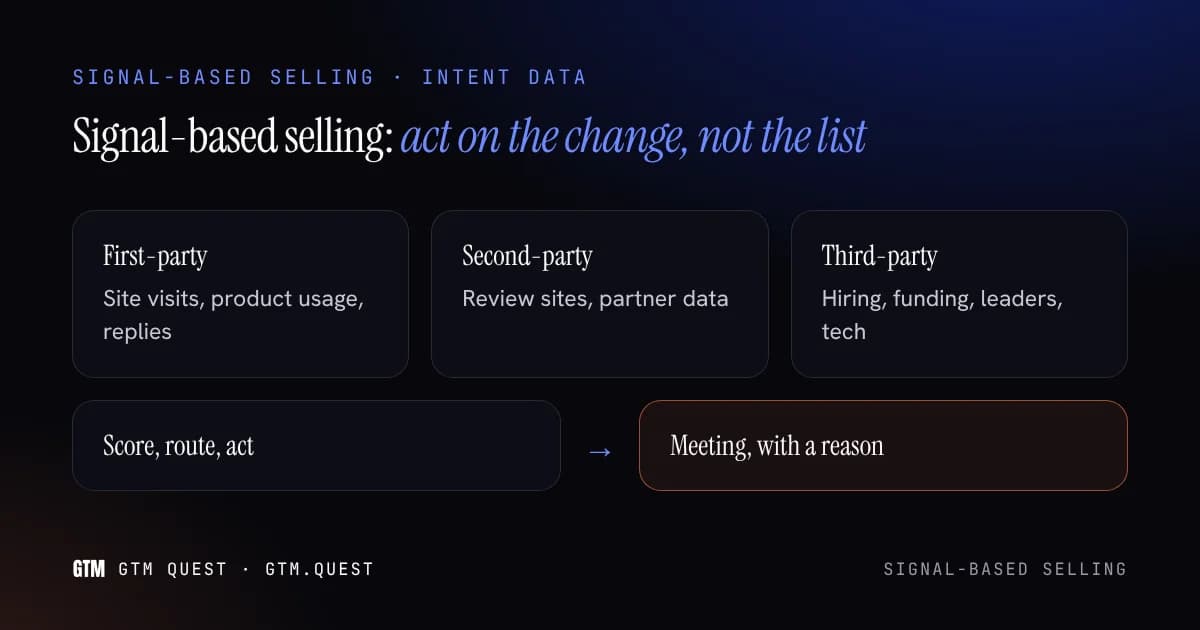
Signal-based selling means contacting an account because something changed that makes a purchase more likely, and saying why.
A new leader, a funding round, a job post that names your problem, three visits to your pricing page.
The signal sets the timing; the reason goes in the first line.
GTM Quest builds signal-based outbound systems in Clay and your CRM.
This guide covers what counts as a signal, how to score and route one, how long it stays useful, the privacy limits on website identification, and how to prove it works.
Reviewed by Dan Keegan, GTM Quest · October 16, 2026 · 21 sources linked below
How a signal becomes a meetingscored, routed, reviewed, measured
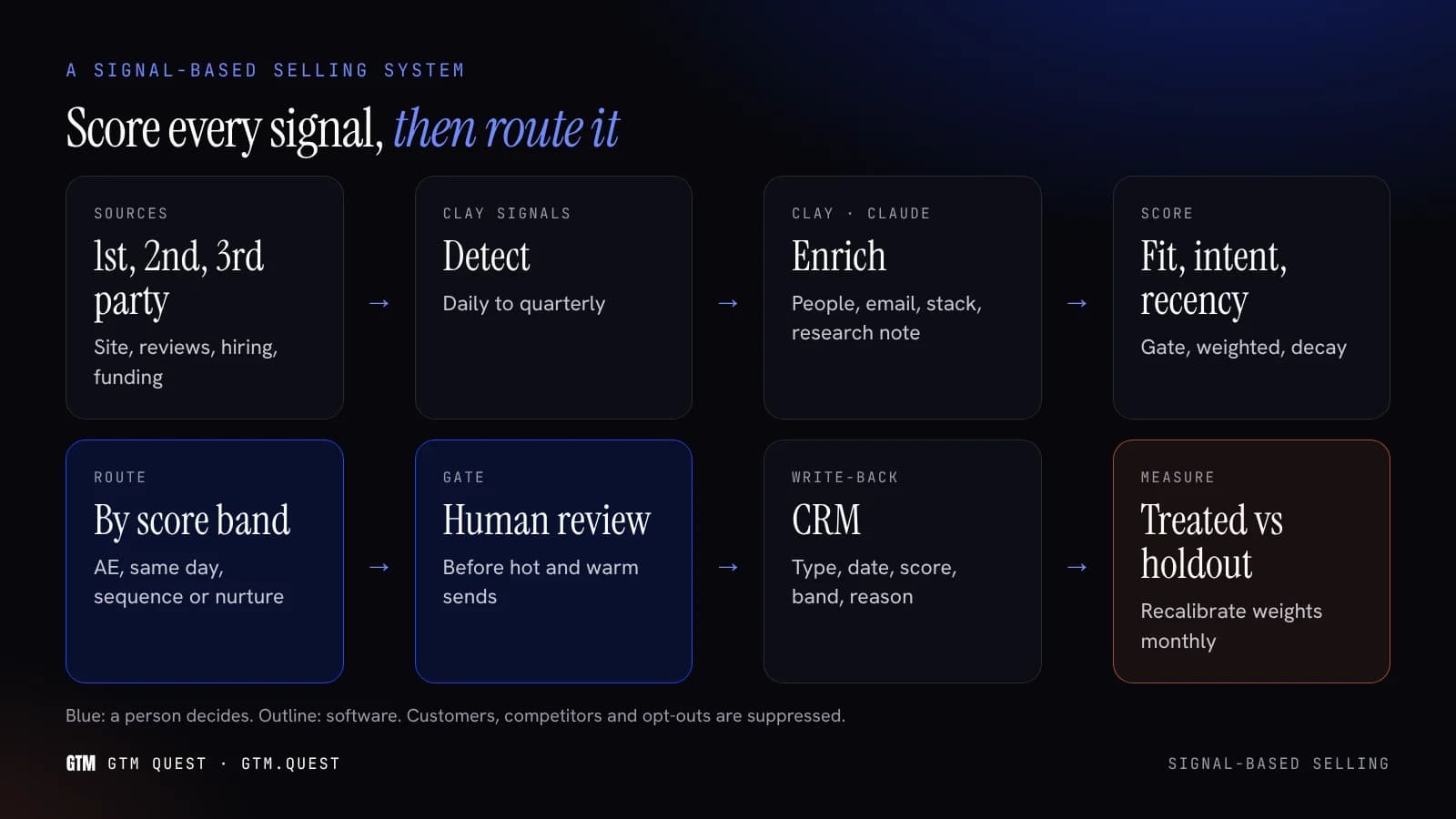
- 01Detect the changeDAILY TO WEEKLYCLAY SIGNALS
- 02Enrich and scoreSAME DAYFIT × INTENT × RECENCY
- 03Route to an ownerSAME DAYCRM · SLACK
- 04Act, then measure liftEACH SPRINTHOLDOUT GROUP
Signals acted on without a stated reason0
01/ the definition
What is signal-based selling? and how it differs from intent data
Signal-based selling is a way of prioritizing and timing sales outreach around observable events at an account: a change in people, money, technology, hiring or behavior that makes a purchase more likely now than last month.
Outreach is triggered by the event and refers to it.
The opposite is list-based selling, where every account in a segment gets the same sequence on the same day.
Intent data is one kind of signal, not a synonym.
It usually means evidence that an account is researching a topic, either on your own site or across other sites.
Bombora, which says it invented the B2B intent data category, describes its product as research activity collected from a co-op of publishers and B2B sites.
Hiring, funding and leadership changes are signals too, and often better ones, because they are facts rather than inferences.
The case for it rests on two findings.
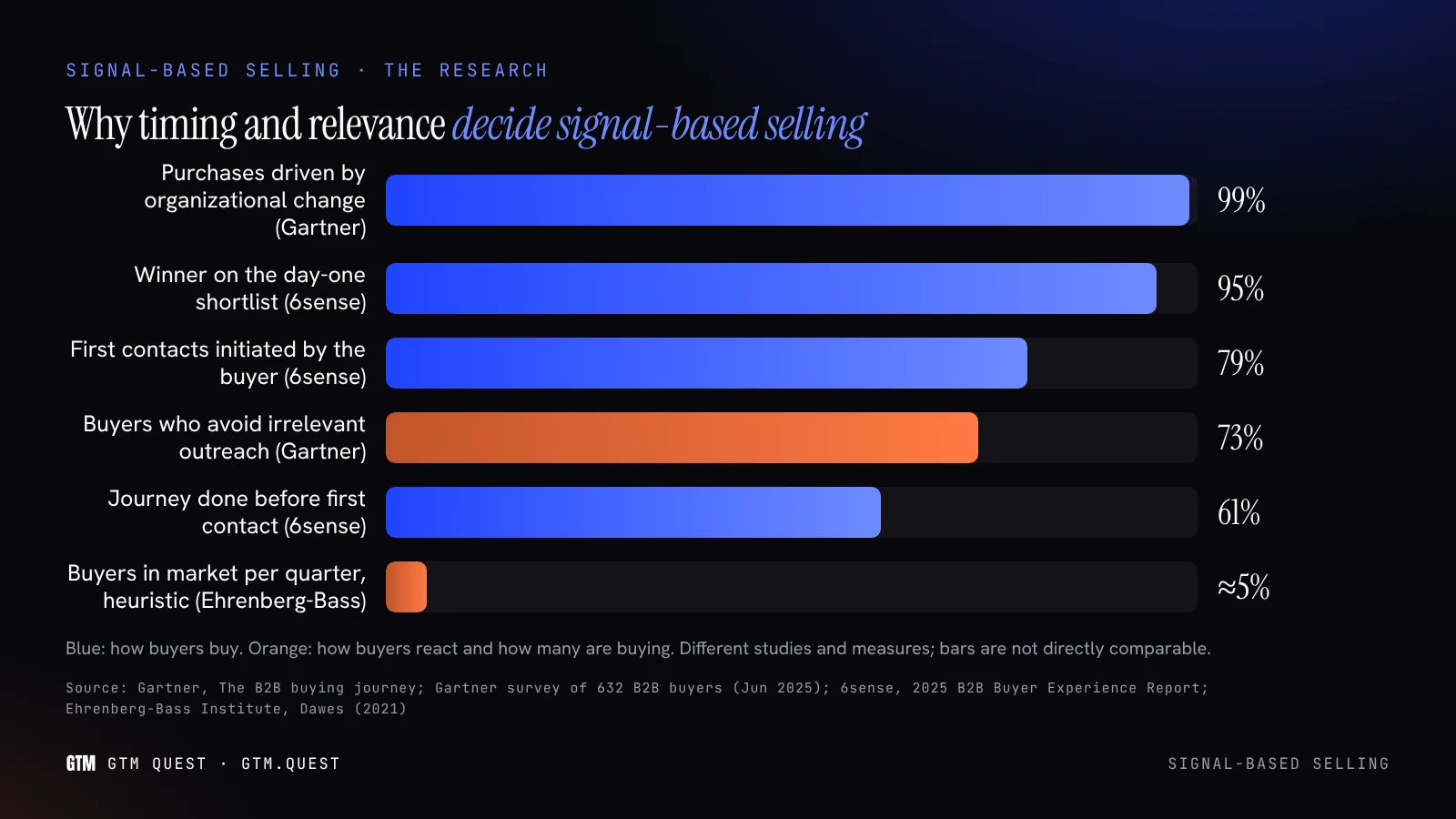
Gartner reports that 99% of B2B purchases are driven by organizational changes, so the change is often the reason to buy.
And most of a market is not buying at any moment: Professor John Dawes of the Ehrenberg-Bass Institute estimates about 5% of business buyers are in market in a quarter, while saying plainly that the 95% figure is a heuristic, not a precise rule.
Signal-based selling vs trigger-based selling vs ABM
"Trigger event selling" is the older name for the same idea, usually with one trigger and one email.
Signal-based selling adds scoring (several signals together), decay (signals expire) and measurement.
Account-based marketing decides which accounts matter; signals decide when to act on them.
Most teams need both, which is why our account-based marketing strategy guide uses the same signal model.
02/ buying signals
Types of buying signals first-party, second-party, third-party
Group signals by who owns the data.
Ownership decides how reliable the signal is, how much it costs and which privacy rules apply.
Vendor descriptions are each vendor's own, checked on October 16, 2026.
Rule of thumb. First-party signals are the most reliable and the most regulated.
Third-party signals are the easiest to buy and the easiest to misread.
Second-party sits between them.
Start with what you own.
03/ scoring
How to score buying signals fit, intent, recency, then combinations
A single signal is weak evidence.
A score combines who the account is, what it did and how recently, so a rep sees ten accounts worth calling instead of three hundred alerts.
Score fit first, and gate on it
Fit is firmographic and technographic: industry, size, region, stack, the roles that buy.
An account that does not fit the ICP should not reach a rep however loud its signals are.
Fit is a gate, not a bonus.
- ✓ Written ICP agreed with sales
- ✓ Tiers A, B, C by fit
- ✓ Exclusions: customers, open deals, competitors
- ✓ Do-not-contact list across channels
Weight intent by strength and specificity
For example, a pricing page visit might carry 20 points, a G2 compare view 15, a relevant job post 10, a broad topic surge 5.
The numbers are a starting point, not research; you calibrate them against which accounts actually opened opportunities.
- ✓ First-party above third-party
- ✓ Specific topics above broad ones
- ✓ Several people above one person
- ✓ Repeat visits above a single visit
Decay every signal
A signal loses value every day it sits.
For example, halve a website visit's points after a week and drop them after a month; let a leadership change hold value for a quarter.
Without decay, the score fills with stale noise.
- ✓ Half-life per signal type
- ✓ Recalculate daily
- ✓ Expire, do not accumulate
- ✓ Show the age of every signal to the rep
Look for signals that agree
Two independent signals that point the same way are worth more than either alone.
Clay's own examples combine several: it says Vanta watches SOC 2 announcements, compliance-related website changes, funding and CISO job postings together.
- ✓ New leader plus pricing visit
- ✓ Job post plus topic surge
- ✓ Closed-lost plus return visit
- ✓ Competitor removed plus category research
Check the score against outcomes
Every month, compare score bands with what happened: meetings held, opportunities, wins.
If the top band does not convert better than the middle band, the weights are wrong, not the reps.
- ✓ Conversion by score band
- ✓ Which signals preceded won deals
- ✓ Drop signals that never predict
- ✓ Change one weight at a time
Gartner's research is the reason to be strict: 73% of B2B buyers actively avoid suppliers who send irrelevant outreach.
A badly scored signal program sends more irrelevant outreach, faster.
04/ timing windows
How long a buying signal stays useful our starting windows by signal
There is no published benchmark for signal decay that we would trust across markets.
These are the windows we start with and then test.
Treat them as defaults to change, not findings.
Timing is relative to the buyer, not to you. 6sense's 2025 study of nearly 4,000 buyers found first contact happens about 61% of the way through the buying journey, buyers initiated 79% of first contacts, and the eventual winner was on the day-one shortlist 95% of the time.
A signal that arrives late in the journey is a reason to be useful, not a reason to pitch.
05/ try it
How many of your accounts are in market now? the 95-5 arithmetic, for your numbers
Set how often your customers replace what you sell and how many accounts fit your ICP.
Signals help you find the small number; they do not make the big number buy sooner.
The method: if customers replace a supplier every 5 years, about 1 in 5 is in market each year and 1 in 20 each quarter. Ehrenberg-Bass Institute ↗
In market this quarter
5%
About 50 of your 1,000 accounts are buying this quarter. 950 are not buying yet.
LinkedIn's B2B Institute, which published the 95-5 rule with the Ehrenberg-Bass Institute, makes the same point from the marketing side: 96% of B2B marketers expected their ads' main effect within two weeks, and it argues most investment should reach the buyers who are not in market yet.
Signal-based selling is the capture half of that plan, not the whole plan.
06/ routing
How to route signals who acts on what
Routing decides whether a signal becomes a conversation or a Slack notification nobody opens.
Route by score band and by who already owns the account.
An open deal or a customer
The signal
Any signal on an account with an open opportunity or an active customer
The play
Alert the owner with context.
Never start an SDR sequence over the top of a live deal.
Owner: AE or CSM
Top score band, in ICP
The signal
First-party intent plus fit, often combined with a people or hiring change
The play
Same-day, human-written outreach to two or three people in the buying group, citing the reason.
Owner: SDR or AE
Middle band
The signal
One strong third-party signal, or first-party intent on a tier B account
The play
A short, signal-specific sequence after human review; LinkedIn engagement from the rep.
Owner: SDR
Low band or weak signal
The signal
Topic surge, category research, a single visit
The play
Add to ad audiences and content nurture.
No cold email on this alone.
Owner: Marketing
Out of ICP or excluded
The signal
Customer, competitor, student, partner, opted out, or a sole trader you cannot email
The play
Log and drop.
Suppression is part of routing, not an afterthought.
Owner: RevOps
If your team cannot staff the hot band within a day, buy fewer signals.
A GTM consultant or our free GTM scorecard will tell you whether outbound capacity, not data, is the real constraint.
07/ in practice
Signal-based outbound in Clay and your CRM what it actually looks like
In Clay, a signal is a monitor on a table or an audience segment.
Clay's documentation lists the built-in types: topic intent, new hires, promotions, job changes, job postings, news and fundraising, and web intent.
Each reads an identifier (a company domain or a person's profile URL) and runs on a schedule from daily to quarterly; topic intent runs weekly at most.
Signals cost credits.
Clay says it charges per result returned or per record checked, and shows an estimate before a signal runs.
Web intent, its website-visitor signal, needs a Growth or Enterprise plan; Clay's pricing page listed Growth at $446 a month when we checked on October 16, 2026.
Watch a small, well-fitted account list rather than the whole market.
A working build has five parts: a table of target accounts and contacts deduplicated against the CRM; signal columns; enrichment (people search, verified email, tech stack, a Claygent research note); a score formula; and actions that write to the CRM, alert Slack or queue a draft in the sequencer.
Clay says signals can also be built from any of its 200+ enrichments or an AI agent query, which is how custom signals such as "changed their pricing page" get made.
AI is good at turning a signal into a reason for the first line; we keep a person between the draft and the send, as on our AI SDR page.
The CRM fields that make signals usable
Put the result in the CRM, not only in Clay, so reps work from one place and you can measure it.
At minimum: last signal type, last signal date, signal score and score band, signal reason (one human-readable sentence), routed to, and signal cohort (treated or holdout).
Our GTM tech stack guide covers where each tool sits, and the Clay experts page covers who builds this if you do not.
08/ the rules
Privacy limits on signals and website identification UK, EU and US
Most signal data is about companies.
The moment it names a person, privacy law applies, and website identification is where teams most often cross that line.
From the official pages; this is not legal advice.
What person-level identification vendors say. RB2B, for example, says its person-level identification works on US visitors only, with company-level identification elsewhere, and that customers who enable international tracking must run a consent tool and are responsible for its configuration.
It claims 30 to 40% of visitors identified at the person level.
Those are RB2B's figures, not a benchmark.
Our default. Company-level identification behind proper consent in the UK and EU; person-level only for US traffic, only after legal review, and never quoted back to the person ("I saw you were on our pricing page" is a privacy notice nobody asked for).
Lead with the reason the account matters, not with the surveillance.
09/ measurement
How to measure lift from signal-based selling a holdout, not a dashboard
Signals select accounts that were already more likely to buy.
Compare signal accounts with ordinary accounts and you will always "win".
The only honest test compares like with like.
- 01
Define the population first
In-ICP accounts that fire a given signal in the test period. Fix the rules before you start.
SCOPE - 02
Randomly hold some back
For example, 20% of signal-firing accounts get your normal motion (or nothing) instead of signal-led outreach. Randomize by account, not by contact.
HOLDOUT - 03
Pick one primary metric
Meetings held or opportunities created per account within a fixed window. Not emails sent, not opens.
METRIC - 04
Run long enough to count
Small B2B samples are noisy. Run until both groups have enough accounts and outcomes to compare, and do not peek and stop early.
TIME - 05
Calculate lift
Lift = (treated rate minus holdout rate) divided by holdout rate. For example, 6% against 4% is 50% lift. Those numbers are an illustration, not a benchmark.
MATH - 06
Report cost per incremental opportunity
Signal, data and people costs divided by the extra opportunities over the holdout. That is the number that justifies the budget.
COST
Common traps: crediting the signal for deals already in progress, counting meetings booked rather than held, changing the score weights mid-test, and letting reps cherry-pick from the holdout.
If you cannot hold accounts back, compare score bands over time instead and say so in the report.
10/ where to start
Which signals to start with pick your situation
Most teams should start with two or three signals they can act on, not a subscription to everything.
What does your go-to-market look like today?
First-party first
Start with your own site and CRM
If in-ICP companies already visit, company-level web intent on your high-intent pages plus closed-lost accounts returning is the cheapest, strongest start.
- ✓ Pricing, integrations and security pages
- ✓ Closed-lost accounts from the last year
- ✓ Consent set up before identification
- ✓ Same-day routing for the top band
Add one third-party signal only once routing works.
Product signals
Product usage beats any purchased signal
Sign-ups from in-ICP domains, teams hitting limits and new seats are the best signals you will ever get.
The work is joining product data to CRM accounts.
- ✓ Domain-to-account matching
- ✓ Activation and usage thresholds
- ✓ Alert the owner, not a sequence
- ✓ Fit gate before sales touches it
This is mostly data engineering. See our GTM engineer page.
Third-party
Hiring and people moves
With no traffic yet, the reliable signals are public: job posts that name your problem, a new leader in the buying role, past champions changing companies.
- ✓ One job-post signal with clear keywords
- ✓ New leader in the buying role
- ✓ Champion job changes
- ✓ Human review of every first line
Entering the US? See our ABM agency US page.
ABM
Signals across the buying group
With a fixed account list, signals tell you which accounts to move up a tier this month and who in the buying group to reach.
- ✓ Engagement from several people
- ✓ Review-site and topic research
- ✓ Leadership changes in the group
- ✓ Ads to the watch band
An ABM agency runs the account side; signals feed it.
If you want the build done for you, our outbound agencies guide explains what to ask any agency about signals: whose data, whose domains, and what they report.
11/ our service
How GTM Quest builds signal-based selling Clay, Postgres and Claude, with a person on every send
Our stack is the Quest System: Neon Postgres for the account data and history, Clay for enrichment and signals, Claude for research and drafts.
Everything runs in accounts you own.
Write the ICP and the exclusions
We agree fit criteria and tiers with your sales team, and list who must never be contacted: customers, open deals, partners, competitors, opted-out contacts.
- ✓ Fit tiers A, B, C
- ✓ Exclusion and suppression lists
- ✓ Deduplicated against your CRM
- ✓ Account history in a database you own
Choose two or three signals and wire them
We pick the signals most likely to predict a deal in your market, set them up in Clay with the right cadence and estimate the credit cost before anything runs.
- ✓ First-party where you have it
- ✓ One or two third-party signals
- ✓ Consent and privacy review
- ✓ Credit budget agreed up front
Score, decay and route
A fit gate, weighted intent, decay by signal type and routing rules by score band.
Results land in CRM fields and in each owner's alerts.
- ✓ Score formula you can read
- ✓ Bands: hot, warm, watch, suppress
- ✓ Owner routing from the CRM
- ✓ Signal reason in one sentence
Research, draft, review, send
Claude writes a short research note and a first draft that cites the signal.
A person approves it, sends it and handles the reply.
- ✓ Every fact traced to a source
- ✓ Human approval before send
- ✓ Authenticated sending domains
- ✓ Replies answered by people
Holdout and monthly calibration
We hold back a share of signal accounts from the start, report meetings held and opportunities against the holdout, and adjust one weight at a time.
- ✓ Treated vs holdout
- ✓ Conversion by score band
- ✓ Signals that never predict get cut
- ✓ A written next step each month
We work as a GTM agency, not a data vendor, and we do not resell signal data.
If you are comparing us with a go-to-market agency that only runs campaigns, ask who owns the Clay workspace and the CRM fields when the engagement ends.
Every engagement is scoped and quoted in writing after the first call.
15 minutes · video or phone
Book 15 minutes on signal-based selling
Tell us who you sell to, what data you have and which signals you are watching. We tell you which two or three signals are worth acting on first, what the routing should look like and how to measure it, whether or not you work with us.
- 0115 minutes, video or phone
- 02We look at your ICP, CRM and website traffic
- 03A written next step after the call
- 04Clay, your CRM, or neither
Pick a day that suits · live availability
12/ questions
Signal-based selling FAQ
What people search for about buying signals, intent data and signal-based outbound, answered plainly and with sources.
Prioritizing and timing outreach around observable changes at an account, such as a new leader, a funding round, a relevant job post or visits to your pricing page, and referring to that change in the message.
See the definition.
Outbound prospecting triggered by scored signals rather than sent to a whole list at once.
In practice it is built in a tool such as Clay, scored, routed to an owner and written back to the CRM.
See how it looks in Clay.
Events that make a purchase more likely: first-party ones such as website visits and product usage, second-party ones such as review-site research, and third-party ones such as hiring, funding, leadership changes and technology installs.
Intent data is one kind of buying signal: evidence that an account is researching a topic, on your site or across others.
Hiring, funding and people moves are signals too, and they are facts rather than modeled research.
See the definition.
First-party signals you own (product usage, high-intent page visits, replies, returning closed-lost accounts), then specific second-party research such as G2 compare views.
Broad third-party topic surges are the weakest on their own.
See signal types.
Gate on ICP fit, weight each signal by strength and specificity, decay it with time, add points when independent signals agree, and recalibrate against which accounts actually opened opportunities.
See scoring.
Same day for direct first-party intent such as a demo request or a known contact on your pricing page; within weeks for leadership changes; use weak topic surges for ads rather than email.
These are our defaults, not benchmarks.
See timing windows.
It needs consent for the tracking technology, and the ICO says the analytics exception does not cover profiling visitors based on their IP address or pages visited.
Identifying a named person also needs a lawful basis under GDPR.
See privacy limits.
Yes.
California's exemption for business-to-business personal information expired on December 31, 2022, so B2B contacts in California have the same CCPA rights as other consumers.
Randomly hold back a share of signal-firing accounts, compare meetings held or opportunities per account against that holdout, and report cost per incremental opportunity.
See measuring lift.
Yes.
Clay's documented signals include topic intent, new hires, promotions, job changes, job postings, news and fundraising, and web intent; web intent needs a Growth or Enterprise plan.
See Clay experts if you want it built.
Yes.
We build it in Clay and your CRM with Neon Postgres and Claude, with a person approving every send and a holdout from the start.
See how we build it.

Book 15 minutes · London · UK, US and Europe
Bring your ICP and the signals you are watching. We’ll tell you which ones are worth acting on.
A 15-minute call, a written next step, and a signal-based outbound system scored, routed and measured in accounts you own.
14/ sources
Every source on this page
Each figure above links to one of these. All were opened and checked on October 16, 2026.
- Gartner, The B2B buying journey: key stages and how to optimize themgartner.com
- 6sense, 2025 B2B Buyer Experience Report (nearly 4,000 buyers, Nov 2025)6sense.com
- Ehrenberg-Bass Institute, John Dawes, Advertising effectiveness and the 95-5 rule (May 2021)marketingscience.info
- Gartner, 61% of B2B buyers prefer a rep-free buying experience (632 buyers, Jun 2025)gartner.com
- Bombora, Company Surge intent databombora.com
- Clay, Announcing Web Intentclay.com
- G2 Documentation, Buyer Intentdocumentation.g2.com
- Clay Docs, Signals in Clayuniversity.clay.com
- Clay, Signalsclay.com
- G2 Documentation, HubSpot list of companies that viewed your G2 profile recentlydocumentation.g2.com
- LinkedIn Marketing Blog (B2B Institute), Why you should follow the 95-5 rule (May 2022)linkedin.com
- Clay, Pricingclay.com
- ICO, Storage and access technologies: what are the exceptions?ico.org.uk
- ICO, Final storage and access technologies guidance published (Apr 29, 2026)ico.org.uk
- ICO, Guidance on the use of storage and access technologiesico.org.uk
- ICO, UK organisations stand to benefit from new data protection laws (Jun 2025)ico.org.uk
- ICO, Business-to-business marketingico.org.uk
- California Privacy Protection Agency, FAQcppa.ca.gov
- California Privacy Protection Agency, Information for data brokerscppa.ca.gov
- RB2B Help Center, Global visitor trackingsupport.rb2b.com
- RB2B, FAQrb2b.com