
GTM audit · Go-to-market audit · Revenue audit
GTM audit find the leak before you buy the fix
A GTM audit is a structured review of how your company finds, wins and hands over customers.
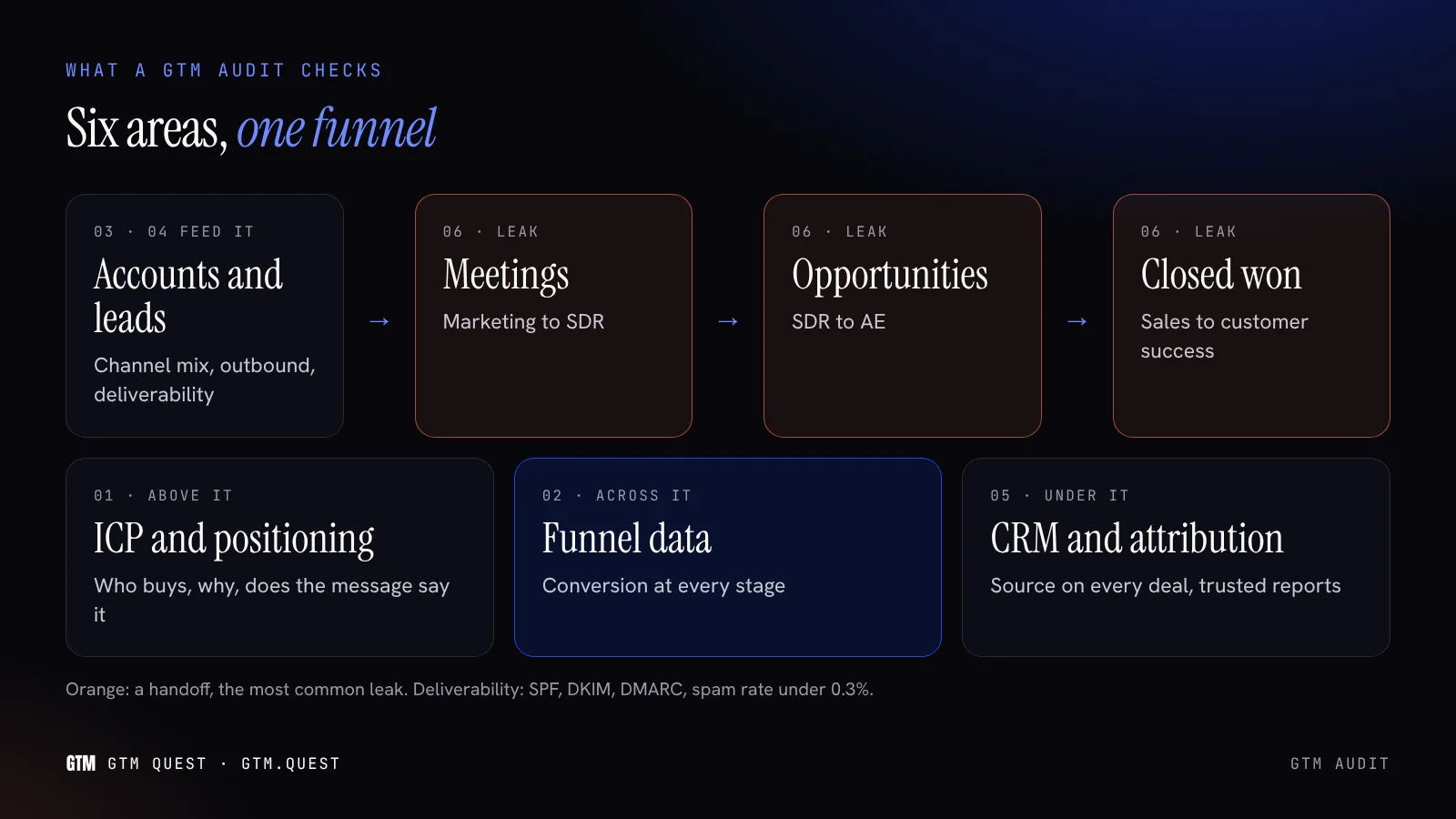
It checks six things: who you sell to, what the funnel data says, which channels work, whether your outbound reaches the inbox, whether the CRM can be trusted, and where deals drop between teams.
This page gives you the full checklist to run yourself, the data to gather and what a good report looks like.
If you want a quick read first, our free GTM scorecard takes about two minutes and shows your score without asking for an email.
Reviewed by Dan Keegan, GTM Quest · October 16, 2026 · 10 sources linked below
How a GTM audit runs with usdiagnose first, fix second
- 01Free GTM scorecardTWO MINUTESSELF-SERVE
- 0215-minute callWEEK 0SCOPE AND ACCESS
- 03Data, systems, interviewsWEEKS 1 TO 2CRM · DOMAINS · TEAM
- 04Written report and readoutWEEK 3RANKED FIXES · OWNERS
PriceQuoted in writing after the call
01/ the definition
What is a GTM audit? and what it is not
A GTM audit (go-to-market audit) is a review of the whole system that turns a target market into revenue: the ideal customer profile, the message, the channels, the tools, the data and the people.
It ends in a written diagnosis and a ranked list of fixes.
It is not a tool review, a website teardown or a sales training needs analysis, although it touches all three.
Those look at one part.
An audit looks at the joins between the parts, because that is where most pipeline is lost: marketing leads nobody follows up, outbound to accounts sales would never close, a CRM that cannot say which channel produced a deal.
The output should be short enough to act on.
A good audit tells you the three to five problems that cost the most, the evidence for each, who owns the fix and what to stop doing.
If you are new to the term, start with what GTM means.
GTM audit vs sales and marketing audit vs revenue audit
A sales and marketing audit usually reviews the two functions side by side: marketing plans, campaigns and content, then sales process, team and pipeline.
A revenue audit is often run by RevOps or finance and focuses on the numbers: pipeline coverage, conversion by stage, win rates, sales cycle and forecast accuracy.
A GTM audit covers both and adds the strategy layer above them: is the ICP right, and does the positioning match how buyers buy?
The labels overlap and vendors use them loosely.
Judge any audit by its scope, not its name.
The six areas below are the scope we think a GTM audit needs.
02/ scope
What a GTM audit covers six areas, in order
The order matters.
A deliverability fix will not help if you are emailing the wrong accounts, and a clean CRM will not help if nobody agreed what a qualified lead is.
01
ICP and positioning
Who buys, why, and whether your message says it.
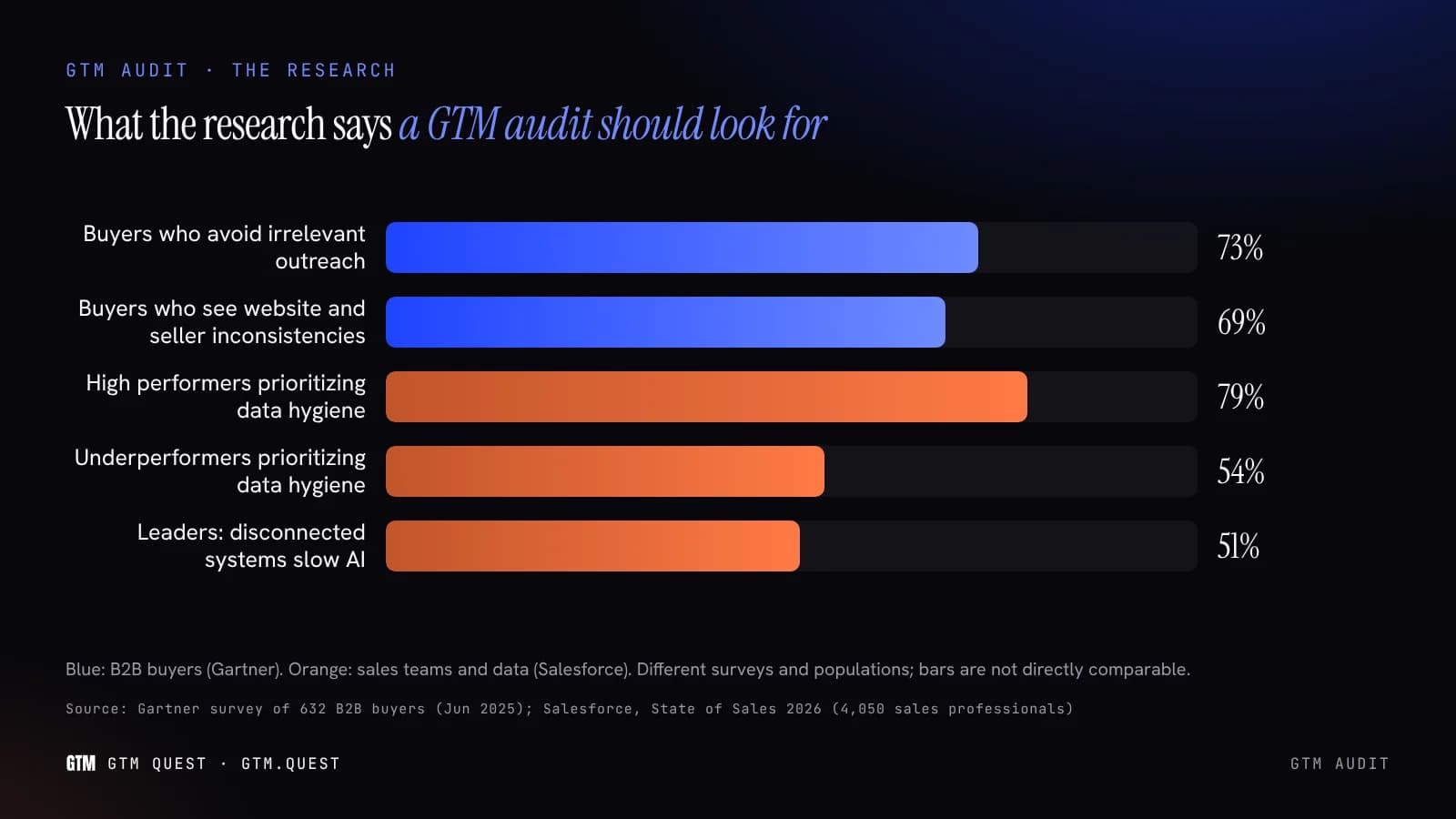
Gartner found 69% of B2B buyers report inconsistencies between a supplier's website and what its sellers say, so the audit compares the two.
- ✓ Written ICP agreed by sales and marketing
- ✓ Closed-won vs closed-lost by segment
- ✓ Message on site vs in sales decks
- ✓ Competitors buyers actually compare you with
02
Funnel and conversion data
Stage-by-stage conversion, sales cycle length and win rate, by source and segment.
The goal is to find the one stage where the drop is worst.
- ✓ Lead to meeting to opportunity to won
- ✓ Cycle length by segment
- ✓ Win rate by source
- ✓ Pipeline coverage against target
03
Channel mix
Which channels produce pipeline, not just leads, and what each costs.
Gartner reports marketing budgets at 7.8% of company revenue in 2026, essentially flat, so most teams have to move budget between channels rather than add it.
- ✓ Pipeline and revenue by channel
- ✓ Cost per opportunity by channel
- ✓ Channels you pay for that produce nothing
- ✓ Channels your buyers use that you ignore
04
Outbound infrastructure and deliverability
Whether your emails reach the inbox and your sequences reach the right people.
Gmail requires senders to keep spam rates reported in Postmaster Tools below 0.3%; past that, good email goes to spam too.
- ✓ SPF, DKIM and DMARC on every sending domain
- ✓ Spam rate and bounce rate per domain
- ✓ Sequence copy, volume and targeting
- ✓ Opt-out handling and suppression lists
05
CRM hygiene and attribution
Whether the CRM can answer basic questions.
Salesforce found 79% of high-performing sales teams prioritize data hygiene, against 54% of underperformers.
- ✓ Duplicates, missing fields, stale contacts
- ✓ Lifecycle stages defined and used
- ✓ Source captured on every deal
- ✓ Reports leadership trusts
06
Team and handoffs
Who owns each stage, how leads pass between marketing, SDRs and account executives, and how fast.
Most audits find the biggest losses here, at the joins.
- ✓ Lead routing and response time
- ✓ Agreed definition of a qualified lead
- ✓ SDR to AE handoff notes
- ✓ Who owns go-to-market day to day
Our free GTM scorecard asks seven questions that map onto these areas: ICP clarity, pipeline predictability, channel coverage, intent and data, measurement, outbound and ownership.
Use it to see which areas to audit first.
03/ do it yourself
GTM audit checklist run it yourself in an afternoon
Work down the list with your CRM, your sending tool and one person from sales and one from marketing in the room.
Mark each line pass, partial or fail.
The red flags are the patterns we look for first.
Scoring it. Any "fail" in the ICP or handoff rows matters more than a fail in channels or tools, because it makes every downstream fix less effective.
If you have more than four fails, fix the foundations before buying anything new.
Our GTM strategy guide covers the ICP and positioning work in detail.
04/ outbound benchmarks
Outbound rules a GTM audit checks against from the official pages
Most outbound problems an audit finds are infrastructure problems.
These are the published rules to test your setup against.
This is not legal advice.
The FTC is explicit that you cannot contract away your legal responsibility by hiring someone else to send.
If an agency or tool sends on your behalf, the audit covers its setup too.
For the infrastructure itself, see our GTM tech stack guide and our cold email agencies page.
05/ before you start
Questions and data to prepare for any GTM audit
- 01
Twelve months of closed deals
Won and lost, with industry, company size, buyer role, source, deal value and cycle length. This is the single most useful export.
CRM EXPORT - 02
Funnel numbers by stage
Leads, meetings, opportunities and wins by month and by source for at least two quarters, plus the definitions you used for each stage.
FUNNEL - 03
Spend by channel
Paid media, tools, agencies and headcount by channel, so cost per opportunity can be calculated.
BUDGET - 04
Access to sending tools and domains
Read access to your sequencer, DNS records and Google Postmaster Tools, plus a list of every domain that sends email.
OUTBOUND - 05
Your written ICP, messaging and decks
Whatever exists, however rough: ICP doc, website copy, first-call deck, sequences. Missing documents are a finding too.
POSITIONING - 06
Thirty minutes with each role
Marketing, an SDR, an account executive, customer success and whoever owns the CRM. Ask each where they think deals are lost.
INTERVIEWS
Five questions to answer before day one: Who are our best ten customers and why did they buy?
Where did our last ten opportunities come from?
What is our win rate, and against whom?
What happens to an inbound lead in the first hour?
Who decides when pipeline is short?
06/ the evidence
Why run a GTM audit now? three findings from the research
Buyers punish bad targeting. Gartner's survey of 632 B2B buyers found 73% actively avoid suppliers who send irrelevant outreach and 61% prefer a rep-free buying experience overall.
An audit that tightens the ICP and the message protects accounts you have not met yet.
Sellers get little time with buyers. In an earlier Gartner survey of 750 buyers in complex purchases, buyers spent just 17% of their buying time meeting with suppliers, about 5% each if three are in the running.
That survey dates from 2018, but the point holds: most of the decision happens on your website, in peer conversations and in content, which is why the audit checks positioning and channels, not only the sales team.
Data decides whether anything else works. Salesforce's State of Sales 2026 reports that 51% of sales leaders with AI say disconnected systems are slowing their AI initiatives, and 74% of sales professionals are focusing on data cleansing.
Every tool you add, from intent data to an AI SDR, sits on the CRM the audit inspects.
Budgets add pressure.
Gartner says marketing budgets are 7.8% of revenue in 2026, and its own commentary notes paid media now takes 31.4% of marketing budgets, funded by cuts to agencies.
With little new money, an audit is how you find what to move.
07/ the deliverable
What a good GTM audit report contains and what to send back
The report is the product.
If it is a 60-slide deck of observations with no order, ask for a rewrite.
01
A one-page summary
The three to five problems that cost the most pipeline, in order, each in one sentence a board member would understand.
If it needs two pages, it is not ranked yet.
02
Evidence for every finding
Each finding links to the data: the export, the conversion table, the DNS record, the interview quote.
Opinions are labeled as opinions.
No finding without a source.
03
A ranked fix list
Each fix with an estimate of effort, the expected effect and what it depends on.
Foundations (ICP, definitions, data) come before channels and tools.
Ranked by impact over effort.
04
An owner for every fix
A named role, not "the team".
Where nobody internal can own it, the report says so and says what kind of help fits: a hire, a contractor or an agency.
Unowned fixes do not happen.
05
A 30, 60, 90 day plan
What to do this month, next month and the month after, with the measures that will show whether each fix worked.
Measures agreed before the work starts.
06
What to stop doing
Channels, tools, campaigns and meetings that cost money or time and produce no pipeline.
Often the fastest savings in the report.
The most skipped section, and the most useful.
Watch for conflicts of interest. An audit written by a firm that sells one fix tends to find that fix.
Ask whoever audits you what they would recommend if they could not do the work themselves.
We include that answer in ours.
08/ timeline
How long does a GTM audit take? our working estimate
For a single-product B2B team with one CRM and a handful of channels, we plan on about three weeks of elapsed time.
Most of the time goes on getting data access and interviews scheduled, not on analysis.
Larger or multi-product teams take longer.
Take the free GTM scorecard
Seven questions, about two minutes, with your score shown straight away and no email needed.
It tells you and us which areas to audit first.
- ✓ ICP clarity
- ✓ Pipeline predictability
- ✓ Channel coverage
- ✓ Measurement and outbound
15-minute call and scope
We agree which of the six areas to cover, what data to pull and who to interview.
You get a written scope and price after the call.
- ✓ Areas in and out of scope
- ✓ Data and access list
- ✓ Interview list
- ✓ Readout date
Data and systems
We read the CRM exports, the funnel numbers and the sending setup.
Read-only access, in your accounts, nothing copied that you have not agreed.
- ✓ Closed-won and lost analysis
- ✓ Stage conversion
- ✓ Domain and DNS checks
- ✓ CRM sample audit
Interviews and positioning
Short interviews with each role, a read of your website and sales materials, and a look at the accounts you are targeting now.
- ✓ Marketing, SDR, AE, CS, RevOps
- ✓ Website vs sales message
- ✓ Current target list vs ICP
- ✓ Handoff walk-through
Report and readout
A written report with a one-page summary, evidence, ranked fixes, owners and a 30, 60, 90 day plan, then a live readout with your leadership team.
- ✓ One-page summary
- ✓ Ranked fixes with owners
- ✓ What to stop
- ✓ Measures for each fix
After the audit you can run the fixes yourselves, hire for them or ask us to.
Every engagement is scoped and quoted in writing after the first call; we do not publish a fixed audit price because scope varies with the number of systems, channels and teams.
09/ decision
Who should run your GTM audit? pick your situation
Four routes, each right for someone.
The right one depends on how much you already know and who will own the fixes.
Where are you today?
Free scorecard
Start with the GTM scorecard
If you do not yet know whether you have a go-to-market problem, take the two-minute scorecard.
A score of 19 or more out of 21 suggests you probably do not need outside help yet.
- ✓ Seven questions
- ✓ Score shown without an email
- ✓ Weakest areas highlighted
- ✓ Optional written breakdown
Internal audit
Run the checklist yourselves
If someone internal owns the CRM and has a few days, the checklist above will surface most problems.
The risk is blind spots: teams rarely audit their own handoffs honestly.
- ✓ Use the checklist on this page
- ✓ Bring sales and marketing into one room
- ✓ Rank fails by the order of the six areas
- ✓ Book an outside view on the top two
Cheapest route, if the findings get acted on.
GTM consultant
An independent GTM consultant
A consultant who does not sell the fix gives the most neutral diagnosis.
You then need someone to carry out the plan.
- ✓ No delivery bias
- ✓ Senior judgment on strategy
- ✓ You own the execution
- ✓ Ask for evidence on every finding
See our GTM consultant guide, or a fractional leader on fractional.quest.
GTM agency
A GTM agency that audits and builds
An agency can audit and then build the fixes, which saves a handover.
Ask what it would recommend if it could not do the work, and keep everything in your own accounts.
- ✓ Audit and delivery in one team
- ✓ Ask for the "if not us" answer
- ✓ Your CRM, domains and data
- ✓ Short initial term after the audit
This is how GTM Quest works. See the timeline above.
For account-based programs, an ABM agency will audit target-account coverage in more depth.
For how agencies differ from consultants, read what a go-to-market agency does.
10/ what comes next
After the audit the fixes we see most often
ICP and positioning. Rewriting the ICP from closed-won data and aligning the website with what sellers say.
This is strategy work, covered in our GTM strategy guide.
Signals and targeting. Replacing static lists with accounts that show a reason to buy now, such as hiring, funding or job posts that name the problem.
See signal-based selling.
Systems and data. Cleaning the CRM, defining lifecycle stages, capturing source on every deal and connecting enrichment and sending tools.
See our GTM tech stack guide, the GTM engineer role, and HubSpot vs Salesforce if the CRM itself is in question.
Team and handoffs. Routing rules, response-time targets and an agreed qualified-lead definition.
Sometimes a missing role: our RevOps agencies page covers outside help for this layer.
GTM Quest works as a GTM agency across all four, from London with US and UK teams.
15 minutes · video or phone
Book 15 minutes about a GTM audit
Bring your scorecard result if you have one. Tell us what you sell, who to, and where you think pipeline is leaking. We tell you which parts of the audit matter for you, what data to pull, and whether you need an outside audit at all.
- 0115 minutes, video or phone
- 02We look at your scorecard and your funnel
- 03A written scope and price after the call
- 04Your data stays in your systems
Pick a day that suits · live availability
11/ questions
GTM audits FAQ
What people ask before they commission, or run, a go-to-market audit.
A structured review of your go-to-market system: ICP and positioning, funnel data, channels, outbound and deliverability, CRM and attribution, and team handoffs.
It ends in ranked fixes with owners.
See the definition.
Six areas, in order: ICP and positioning, funnel and conversion data, channel mix, outbound infrastructure and deliverability, CRM hygiene and attribution, and team and handoffs.
See what it covers.
A sales and marketing audit reviews the two functions side by side.
A GTM audit adds the strategy layer above them, the ICP and positioning, and focuses on the handoffs between teams.
See the comparison.
Usually a numbers-first review run by RevOps or finance: pipeline coverage, stage conversion, win rate, cycle length and forecast accuracy.
It is one part of a GTM audit's funnel and CRM work.
Yes.
Start with the free GTM scorecard, then work through the checklist with your CRM and one person each from sales and marketing.
The usual blind spot is your own handoffs.
Twelve months of won and lost deals, funnel numbers by stage and source, spend by channel, access to sending domains and Postmaster Tools, and your ICP and sales materials.
See what to prepare.
For a single-product B2B team we plan on about three weeks of elapsed time, most of it waiting for data access and interviews.
That is our working estimate, not an industry benchmark.
See the timeline.
It depends on the number of systems, channels and teams in scope.
GTM Quest scopes and quotes every audit in writing after a 15-minute call; the scorecard is free.
A one-page summary, evidence for every finding, a ranked fix list, an owner for each fix, a 30, 60, 90 day plan and a list of what to stop doing.
See the report.
SPF, DKIM and DMARC on every sending domain, spam rate in Postmaster Tools (Google says below 0.3%), one-click unsubscribe and opt-outs honored across every tool.
See the outbound rules.
A consultant gives the most neutral view; an agency can audit and build.
Whoever you pick, ask what they would recommend if they could not do the work.
See the decision picker.

Free scorecard · 15-minute call · London, US and UK teams
Take the scorecard, then bring us the result. We’ll tell you which part of your GTM to audit first.
Two minutes for the scorecard, 15 for the call, and a written scope and price if an audit is worth doing. If it is not, we will say so.
13/ sources
Every source on this page
Each figure above links to one of these. All were opened and checked on October 16, 2026.
- Gartner, 61% of B2B buyers prefer a rep-free buying experience (632 buyers, Jun 2025)gartner.com
- Salesforce, State of Sales report 2026 (4,050 sales professionals, Feb 2026)salesforce.com
- Gartner, 2026 CMO Spend Survey (401 marketing leaders, May 2026)gartner.com
- Google, Email sender guidelines (Gmail Help)support.google.com
- Google, Email sender guidelines FAQ (Gmail Help)support.google.com
- US Federal Trade Commission, CAN-SPAM Act: a compliance guide for businessftc.gov
- Yahoo Sender Hub, Sender best practicessenders.yahooinc.com
- Gartner, How B2B sales reps maximize customer interactions (750 buyers, Aug 2018)gartner.com
- Gartner, CMO spend in 2026gartner.com
- Fractional Quest, Fractional GTMfractional.quest